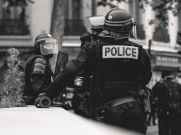


On May 25, 2020, George Floyd died from “cardiopulmonary arrest” after an alleged attempt to pay in a store with a counterfeit twenty-dollar bill. His death shook the whole country. Classes at schools and universities were cancelled. A hard-hearted professor who refused to grade black students more leniently than their white classmates was put on involuntary leave and allegedly threatened to be terminated.1 In silent tribute to George Floyd, the leaders of the Democratic Party kneeled for eight minutes and forty-six seconds on the floor of Emancipation Hall in the U.S. Capitol. Demonstrations, protests, rioting, looting, and acts of arson rocked cities across the United States; the sculptures of “white racists” (including the sculptures of George Washington, Thomas Jefferson, Christopher Columbus, and Miguel de Cervantes) were vandalized. Although the riots caused about $2 billion worth of damage, the liberal media would repeat a mantra about “mostly peaceful protests.” Even those rioters and looters who were arrested and charged often got only a slap on the wrist: their charges were dropped, or they were convicted on lesser counts with no jail time, such as trespassing.2
In retrospect, both the volume of the “protests,” and a very lenient attitude of the American liberal community and officials to rioting and looting that accompanied the “protests,” seem quite strange. Indeed, rather than being a reincarnation of Martin Luther King Jr., Floyd was a drug user who had committed at least nine crimes, including an armed robbery. Several months before Floyd’s death, thirteen children were shot dead in just one city (St Louis) during just a six-month period,3 but there were no protests or kneeling of Democratic Party leaders in silent tribute to them—maybe, because both the murderers and the victims were blacks, while in Floyd’s case the victim was a black, and the arresting policeman was white?
Actually, according to the American “liberals,” this explanation is perfectly correct: in their view, Floyd’s death was a manifestation of “systemic racism and police brutality,” which became the last straw that triggered the protests with acts of violence fully understandable under such circumstances. This argument, however, does not seem to dovetail with certain other observations. It is difficult to believe that “systemic racism” dominates our society and its institutions in a country where blacks have been elected or appointed president, vice-president, Secretary of State, Secretary of Defense, governors, and mayors of such large cities as New York, Boston, Chicago, and Atlanta; where the representation of blacks in the House of Representatives matches their representation in society, and their representation in the Supreme Court almost doubles their representation in the population at large; and where so-called “affirmative action,” despite its recent difficulty in the courts, still gives advantages to blacks when they apply for a job, a government contract, or university admission?
Maybe, as is often claimed, police kill unarmed blacks more often than unarmed white Americans? Some peer-reviewed studies indicate that this is not the case.4 But even if it were true, there is a more obvious explanation for this occurrence than “police racism,” especially in light of the large non-white component of big-city police forces: in 2019 (the year preceding the death of George Floyd), among 7,964 Americans arrested for murder and nonnegligent manslaughter, 4,078 (that is, more than 50 percent) were black.5 Isn’t it quite predictable as Heather Mac Donald points out, that “the more frequently officers encounter violent suspects from any given racial group, the greater the chance that a member of that group will be fatally shot by a police officer?”6
A sad confirmation of this thesis has been observed in the death of a black man, Tyre Nichols, who was beaten to death by five black policemen during a traffic stop. Paradoxically, although a reference to “systemic racism” to explain this murder would seem foolish, it did not prevent liberal advocates from claiming that “the race of the officers involved is far less important than the race of the victim,” and that “there is nothing in our country that is divorced from issues of race.”7
So, why has the thesis about “the systemic racism” of American life and institutions been accepted by a significant part of the public as an undisputable fact? The answer to this question can be found in the continuing spread of neo-Marxist ideology in the United States.
The classical Marxists divided human society into “capitalist exploiters” and “exploited proletarians” and claimed that the proletarians, who “have nothing to lose but their chains,” would become the driving force of future socialist revolutions. But over time, after the Russian Bolshevik revolution of 1917 and the two World Wars, European and American proletarians had much to lose besides their “chains,” and they did not resemble at all the deprived proletarians from Jack London’s and Upton Sinclair’s novels. That is why, the American neo-Marxists have redelegated the role of the “oppressed” group, from assimilated middle-class proletarians to racial, ethnic, and gender minorities, especially blacks, who “will play an integral and leading role in the struggle to overthrow the racist system of capitalist exploitation once and for all.”8
And, just as classical Marxists used their propaganda to radicalize proletarians, the neo-Marxists use the thesis of “systemic racism” in American society and institutions to radicalize the “oppressed” minorities, to legitimize their “struggle for their rights” in the public eye, and to instill a profound sense of guilt in “white oppressors” about their “privileged” position in society.
An interesting parallel can be drawn between the privileges that Bolsheviks provided to Russian proletarians after the October Revolution of 1917, and the privileges that liberal society has provided to black Americans as compensation for being victims of systemic racism. After the October Revolution, having "proletarian origin" became necessary, or at least highly advantageous, for promotion to leadership positions or university enrollment. Moreover, proletarians were not subject to prosecution for robbing the so-called "exploiters;" rather, they were actively encouraged to partake in "looting the looters," with the term "looters" being applied to the bourgeoisie.9 It's worth noting, however, that once the communist leaders consolidated their power, these proletarian privileges were abandoned, and Soviet workers began sharing the poverty and disenfranchisement experienced by the rest of the Soviet population.
The already mentioned “affirmative action” is one example of the privileges granted to blacks in America (as well as to some other historically disadvantaged groups) as compensation for their oppression. Another such “compensation” is a de facto right to perform looting as long as the cost of stolen goods is below $1,000 or the looter “needed stolen goods”10 (of course, this right was not explicitly granted just to blacks, but it is leftists and “young Black activists” themselves who legitimize looting as “ a struggle for racial justice”11). Finally, although the welfare system was not developed specifically to benefit blacks, they are disproportionately represented among its clientele.12
To be sure, some members of the black community have benefited from these privileges. Among them, there are two “affirmative action” presidents—U.S. President Barack Obama and Harvard University President Claudine Gay—who would hardly have been elected to their positions but for their race.13 Another example is Judge Ketanji Brown Jackson, who would not have been considered by President Biden for nomination to the Supreme Court had she not been black and female.
On the other hand, the advantage gained from these privileges for the average black person in the U.S. is far less obvious. For example, many black university students underperform because, thanks to affirmative action, they have been admitted to elite universities without the requisite academic preparedness. Because of this “mismatch,” these students graduate or pass bar exams at lower rates than black students who are not similarly mismatched.14 To be sure, encouraging black youth to commit looting and other crimes by granting them reprieve from serious punishment increases the likelihood of criminalization, which is hardly beneficial for them, their families, and the black community in general. And, finally, there is still the decades-long debate over the role of expanded welfare benefits on black family structure.15
There is, however, a less direct but even more significant negative outcome of the policies aimed at compensating blacks for systemic racism: these policies have promoted in many blacks a "victim mentality" or "victimhood mindset," with its core idea that it is impossible for them to achieve success in an ineradicably “racist” society. The danger of victim mentality has been demonstrated in psychological research of the internal versus external locus of control. Data shows that it is the internal locus of control (viewing outcomes as contingent on one's own actions) rather than the external locus of control (attributing outcomes to external forces) that is linked to both high academic achievement and success in the labor market.16
The preceding discussion largely explains why significant segments of the black population have worse social outcomes today than they did before the implementation of all the “compensation-for-racism” programs and policies.17 In 1960, for example, only 22 percent of black children were raised in a single-parent family; 30 years later, this number was more than three times higher.18
In 1899, black high school students from “the M Street School” outperformed the students attending two of the three white high schools in Washington D.C.19 These days, “over half of black young men who attend urban high schools do not earn a diploma. Of the dropouts, nearly 60 percent will go to prison at some point.” The performance of those black youngsters who stay at school doesn’t leave much room for optimism either: Only 14 percent of black eighth graders achieve proficiency in reading, and only 13 percent of them achieve proficiency in math.20
Finally, it was after the expansion of welfare as a key component of the "War on Poverty" that “black crime began to escalate markedly in the late 1960s and continued to play a major role in the multi-decade crime boom that followed.”21
Although grossly contributing to the above problems that the black community is facing, racial “privileges” have not been the only such contributor. Another such contributor has been thoroughly analyzed by Thomas Sowell. Sowell traces the roots of these problems to the “subculture that goes back for centuries, which has encompassed everything from ways of talking to attitudes toward education, violence, and sex,”22 and which was originated from the white population of the old South. Thomas Sowell writes:
The cultural values and social patterns prevalent among Southern whites included an aversion to work, proneness to violence, neglect of education, sexual promiscuity, improvidence, drunkenness, lack of entrepreneurship, reckless searches for excitement, lively music and dance, and a style of religious oratory marked by strident rhetoric, unbridled emotions, and flamboyant imagery.23
Black slaves, who lived within this subculture for centuries, adopted its elements and carried them to the North after emancipation and through the 1960s and 1970s, and this subculture continues to exert a profound influence on the lives of those in low-income, predominantly black areas to this day.
This view is consistent with the socio-cultural theory of the famous Russian-Jewish psychologist and educator Lev Vygotsky.24 According to this theory, people are not born smart or stupid, moral or immoral, lazy or industrious; it is the culture within which they grow and which they adopt that cultivates certain qualities in them. The mechanism of this process relates to children’s appropriation of the so called “cultural tools” (language, methods of thinking, moral norms, etc) that, having been mastered and internalized, come to mediate their social behavior, problem solving, self-regulation, moral reasoning, etc. In particular, Vygotsky has demonstrated how the language that children acquire and master in the context of their communication with adults becomes their major tool for self-regulation—that is, the ability to resist impulsive actions, manage emotions and attention, follow rules, and do what is necessary rather than what is immediately desirable.
Accordingly, the roots of children’s problems with self-regulation can be found in the history of their early verbal communication with parents. From this perspective, the fact that many black children demonstrate serious problems with self-regulation,25 which later becomes a major reason for their poor school performance, can be attributed to deficiencies in parent-child early verbal communication. And, indeed, one study demonstrated that by the age of four years, the difference in the number of words heard by low SES (socio-economic status) predominantly black American children and higher SES predominantly white American children reaches 30 million.26 This disadvantage, however, can be overcome by providing low-income black children with specially designed intervention. In particular, as our study demonstrated, a Vygotskian-based preschool curriculum makes it possible to substantially promote self-regulation in black American children.27
Thus, providing blacks in the U.S. with various privileges as compensation for “systemic racism” leads to consolidating the major problems they are facing rather than helping resolve them. The right avenue to resolve these problems relates to providing black children with enriched educational opportunities that will help them succeed at school and in life.
Disclaimer
The author is publishing this article in a personal capacity. The views and opinions expressed in this article are solely those of the author and do not necessarily reflect the official policy or position of Touro University or any of its departments or affiliates.
Yuriy V. Karpov, Ph.D., is a professor and associate dean in the Graduate School of Education at Touro University, New York, N.Y. He last appeared in AQ with “Why Are K-12 Schools Turning Out Radicals?” in our Winter 2024 issue.
1 Emma Colton, “Professor Sues UCLA After Refusing to Grade Black Students More Leniently Than Peers,” Fox News, October 2, 2021.
2 Lee Brown, Julia Marsh, “Charges Against Hundreds of NYC Rioters, Looters Have Been Dropped,” New York Post, June 20, 2021.
3 Amanda Holpuch, Lauren Aratani, “Why Are So Many Black Children Being Shot Dead in One US City?” The Guardian, October 1, 2019.
4 Heather Mac Donald, “The Myth of Systemic Police Racism,” The Wall Street Journal, June 2, 2020; Dean Knox, Jonathan Mummolo, “A widely Touted Study Found No Evidence of Racism in Police Shootings. It’s Full of Errors,” The Washington Post, July 15, 2020.
5 “2019 Crime in the Unites States,” FBI: UCR, 2019. https://ucr.fbi.gov/crime-in-the-u.s/2019/crime-in-the-u.s.-2019/tables/table-43
6 Mac Donald, “The Myth of Systemic Police Racism.”
7 Rick Jervis, Jessica Guynn, “When the Officers Are Black: Tyre Nichols' Death Raises Tough Questions About Race in Policing,” USA Today, January 28, 2023.
8 “USA: Black Struggle and the Socialist Revolution”, In Defense of Marxism, June 15, 2020, https://www.marxist.com/black-struggle-and-socialist-revolution.htm
9 James Bunyan, Harold Fisher, Frank Golder, Bolshevik Revolution, 1917-1918: Documents and Materials (Stanford University, Calif., London: Stanford University Press ; H. Milford, Oxford University Press, 1934): 542-543.
10 Rich Lowry, “Mobs of Looters Are Grabbing Goods in California Thanks to Downgraded Shoplifting Laws,” New York Post, November 22, 2021; Steve Pomper, “California DA Says Cops Can’t Arrest Looters if the Looters ‘Needed’ the Stolen Stuff,” National Police Association, https://nationalpolice.org/california-da-says-cops-cant-arrest-looters-if-the-looters-needed-the-stolen-stuff/
11 Marian Jones, “In Defense of ‘In Defense of Looting’,” Lux Magazine, Issue 1: Culture, 2024, https://lux-magazine.com/article/in-defense-of-in-defense-of-looting/; Carlos Ballesteros, “Black Chicago Has Been Looted for Decades,” Injustice Watch, September 1, 2020. https://www.injusticewatch.org/archive/2020/chicago-looting-economic-injustice/; Ria Modak, “A People’s History of Looting,” Harvard Political Review, August 11, 2020, https://harvardpolitics.com/a-peoples-history-of-looting/
12 National Research Council, America Becoming: Racial Trends and Their Consequences: Volume II (Washington, DC: The National Academies Press): 152-173, https://doi.org/10.17226/9719.
13 Seth Forman, American Obsession: Race and Conflict in the Age of Obama (Bangor, Maine: Booklocker.com Inc, 2011); John McWhorter, “Why Claudine Gay Should Go,” New York Times, December 21, 2023.
14 Thomas Sowell, Affirmative Action around the World (New Haven and London: Yale University Press, 2004).
15 Thomas Sowell, Black Rednecks and White Liberals (NY: Encounter Books, 2023): 34-35.
16 Syeda Hasan, Ruhi Khalid, “Academic locus of control of high and low achieving students,” Journal of Research and Reflections in Education, 8, no 1 (2014): 22-33; Rob Millar, Pauline Irving, “Academic locus of control in British undergraduate students,” British Journal of Educational Psychology, 65, no 3 (2011):331–340; Deborah Cobb-Clark, “Locus of Control and the Labor Market,” IZA Journal of Labor Economics, 4, no. 3 (2015), https://doi.org/10.1186/s40172-014-0017-x.
17 Thomas Sowell, “Legacy of the Welfare State,” video, 9:31, https://youtu.be/lm-FqtAOSB8
18 Ibid.
19 Thomas Sowell, “Dunbar High School after 100 Years,” Black Community News, October 6, 2016, https://blackcommunitynews.com/dunbar-high-school-after-100-years/.
20 Matthew Lynch, “Black Boys in Crisis: The School-to-Prison Pipeline,” Education Week, August 8, 2016; “Performance Declines in Basic Mathematics and Reading Skills Since the COVID-19 Pandemic Are Evident Across Many Racial/Ethnic Groups,” NAEP Plus: The Official Blog of the Nation's Report Card, November 9, 2023, https://nces.ed.gov/nationsreportcard/blog/pandemic_performance_declines_across_racial_and_ethnic_groups.aspx?utm_source=chatgpt.com.
21 Barry Latzer, “Subcultures of Violence and African American Crime Rates,” Journal of Criminal Justice, (January–February 2018): 41-49.
22 Thomas Sowell, Black Rednecks and White Liberals (NY: Encounter Books, 2023): 1
23 Ibid, 6.
24 Lev Vygotsky, Thought and Language (Cambridge, MA: MIT Press, 2012).
25 Robert Crosnoe, Carey Cooper, “Economically Disadvantaged Children’s Transitions into Elementary School: Linking Family Processes, School Contexts, and Educational Policy,” American Educational Research Journal, 47, no 2, (2010): 258–291; Cassandra Raver, “Placing Emotional Self‐Regulation in Sociocultural and Socioeconomic Contexts,” Child Development, 75, no 2, (2004): 346–353.
26 Betty Hart, Todd Risley, Meaningful Differences in the Everyday Experience of Young American Children (Baltimore, MD: Paul H. Brookes, 1995).
27 Vera Brofman, Yuriy Karpov, Inna Rabinovitch, “Vygotskian Preschool Education: Promoting the Development of Self-Regulation and Symbolic Thought in Pre-K Children,” International Research in Early Childhood Education, 10, no 2, (1920): 1-15.
Photo by Taylor Brandon on Unsplash