

ARTICLES
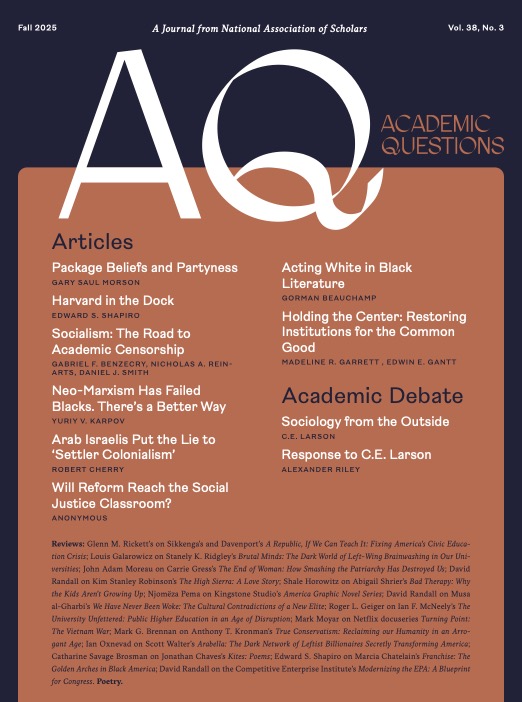
Package Beliefs and Partyness
Gary Saul Morson, Northwestern University.
Literary critic Gary Saul Morson sees in the intellectual conformity of today eerie parallels with Soviet-era thought control. Using Russian literature—from Tolstoy and Dostoevsky to Mandelstam and Solzhenitsyn—Morson explores the dangers of “package thinking,” where individuals adopt entire belief systems uncritically, surrendering their own human distinctiveness.
Harvard in the Dock
Edward S. Shapiro, Seton Hall University.
Historian Edward S. Shapiro examines the report on antisemitism at Harvard commissioned by the school in the wake of its anemic response to the unrest on campus after the Hamas attacks on Israel of October 7, 2023. While the report documents bias in specific academic programs and institutional failures at protecting Jews, it fails to locate academic antisemitism in the school’s suffocating progressive ideology or to articulate a vision for intellectual renewal.
Socialism: The Road to Academic Censorship
Gabriel F. Benzecry, Nicholas A. Reinarts, Daniel J. Smith
Three economists examine data from 1900-2022 and find that the more the state controls economic life, the more constrained academic freedom tends to become.
Neo-Marxism Has Failed Blacks. There’s a Better Way
Yuriy V. Karpov, Touro University.
Educator Yuriy V. Karpov argues that the widespread embrace of the "systemic racism" narrative has not served the nation well. While efforts such as affirmative action and criminal justice leniency have not significantly improved social outcomes, targeted early childhood interventions offer a possible way forward for the most at-risk youth.
Arab Israelis Put the Lie to ‘Settler Colonialism’
Robert Cherry, Brooklyn College.
Economist Robert Cherry offers a thorough rebuttal to the claim—popular among American student protesters and anti-Zionist intellectuals—that Israel is a “white settler-colonial” and “apartheid state.” Drawing on historical, political, and economic evidence, Cherry provides a detailed and nuanced account of the real conditions of Arab citizens living in Israel.
Will Reform Reach the Social Justice Classroom?
Anonymous
Withholding his name to prevent backlash against a college-aged nephew, a veteran college teacher expresses frustration and alarm at the lack of empirical rigor, ideological bias, and political activism embedded in today’s curriculum. Focusing on the social justice pedagogy dominant in criminal justice and related fields, the author suggests that true reform in higher education will require faculty churn amidst a renewed commitment to intellectual pluralism.
Acting White in Black Literature
Gorman Beauchamp, University of Michigan.
Humanities Prof. Gorman Beauchamp explores the recurring figure of the "Oreo"—a black person perceived as trying to be white—in some of the most notable black literature, and observes that such figures are typically portrayed with ridicule and contempt. While such character portraits are often compelling, they likely contribute to intra-racial resentment and hinder black mobility.
Holding the Center: Restoring Institutions for the Common Good
Madeline R. Garrett, Brigham Young University, Edwin E. Gantt Brigham Young University.
Drawing on the work of Philip Rieff and Charles Taylor, two BYU scholars trace the shift of Western society to a secular culture where moral meaning arises solely from human reason and personal autonomy. This shift has profoundly reshaped the university, which now prioritizes technocratic efficiency and social activism over moral formation and the pursuit of truth.
ACADEMIC DEBATE
Sociology from the Outside
C. E. Larson vs. Alexander Riley
A mathematics professor recounts his curiosity about the field of sociology after a student passed the CLEP sociology exam with minimal preparation—something he says is unthinkable for math or science subjects. His conclusion? Sociology lacks causal explanations—the ability to identify how specific inputs produce predictable outcomes—leaving the discipline lacking in theoretical development and testing.
Sociologist Alexander Riley concedes some of Larson’s points, but argues that there must be more to the story, given sociology’s quite considerable contributions to human understanding.
REVIEWS
The fall AQ features fourteen individual book reviews, starting with Glenn M. Rickett’s review of Jeffery Sikkenga’s and David Davenport’s A Republic, If We Can Teach It: Fixing America's Civic Education Crisis, a treatise on the dire state of American civic education and the problems associated with a generation ill-equipped to sustain a modern republic. Appearing for the first time in AQ, NAS research associate Louis Galarowicz is impressed with Stanely K. Ridgley’s Brutal Minds: The Dark World of Left-Wing Brainwashing in Our Universities, a 2023 book whose indictment of DEI programs in higher education as akin to brainwashing still packs a wallop.
John Adam Moreau has mostly good things to say about Carrie Gress’s discussion of “ruinous feminism’s” social harm in The End of Woman: How Smashing the Patriarchy Has Destroyed Us. This is followed by the first of three reviews from David Randall in this issue, an assessment of Kim Stanley Robinson’s The High Sierra: A Love Story. Randall finds the book plodding yet overwrought in its love of nature absent a human element. Shale Horowitz appreciates Abigail Shrier’s Bad Therapy: Why the Kids Aren’t Growing Up, a powerful critique of contemporary psychological practices and the therapeutic culture that permeates our childrearing institutions.
Njomëza Pema looks at Kingstone Studio’s America Graphic Novel Series, which Pema praises for its educational and patriotic intent but criticizes for its failure to deliver compelling storytelling. Then David Randall takes on the widely discussed We Have Never Been Woke: The Cultural Contradictions of a New Elite by Musa al-Gharbi,which despite its flaws offers a powerful indictment of the self-serving nature of elite activism.
Roger L. Geiger thinks Ian F. McNeely’s The University Unfettered: Public Higher Education in an Age of Disruption has a few too many good things to say about the administrative takeover of a public university, especially its adoption of DEI as a core mission. Mark Moyar takes on the Netflix docuseries Turning Point: The Vietnam War, which ignores recent historical works indicating that the war had logical justification and was, in fact, winnable. Mark G. Brennan believes Anthony T. Kronman’s True Conservatism: Reclaiming our Humanity in an Arrogant Age has much to offer conservatives who are willing to reflect critically on their beliefs, while Ian Oxnevad, Senior Fellow for Foreign Affairs and Security Studies at NAS, thinks Scott Walter’s Arabella: The Dark Network of Leftist Billionaires Secretly Transforming America is an invaluable exposé of the use by progressive elites of a vast and largely hidden network of nonprofits to gain and retain power.
At-large AQ poetry advisor Catharine Brosman reviews Jonathan Chaves’s Kites: Poems, a follow-up to his 2023 collection Surfing the Torrent. Edward S. Shapiro says that Marcia Chatelain’s Pulitzer prize-winning book Franchise: The Golden Arches in Black America, fails to acknowledge some of the positive effects the hamburger king has had on black neighborhoods. And, finally, David Randall makes his third appearance with an evaluation of the Competitive Enterprise Institute’s Modernizing the EPA: A Blueprint for Congress, a book that accuses the EPA and environmental activists of making flawed policy based on irreproducible science.
Photo by Hannah Reding on Unsplash