


The Epoch Times is perhaps not the newspaper most frequently read by those who loyally follow Academic Questions, but it deserves a look. I find more articles in it that I read start to finish than I do in the New York Times and the Wall Street Journal, though I take those two daily like pills prescribed to ward off spontaneous human combustion. Unlike the NYT and the WSJ, the Epoch Times greets me like a cheerful neighbor who is glad to see me up and about.
It is not, however, oblivious to the shadows of our age. Each issue is sure to have a spread on the latest deviltry of the Chinese Communist Party and a deeper dive into another facet of Marxism’s destructive record. But these are balanced with straight news and a rich variety of features, among which I recently found, “40 Great Books for Teens.”
The Epoch Times is owned by a company affiliated with the Falun Gong religious movement, which might explain its emphasis on anti-communism and its penchant for wholesome features, but then again maybe not. The ET editors and writers I’ve encountered seem far less ideological than those at the NYT, the WSJ, or other papers that call me up looking for a few words they can quote as evidence that they really do seek conservative voices. (I count as one, though I always tell them I speak for myself, not for any party or faction.) Of those “40 Great Books for Teens,” I counted eleven that I’ve read, including Animal Farm, Treasure Island, and Uncle Tom’s Cabin. Being well past my teens, I could be exempt from reading the other twenty-nine titles, but something about the list came across to me as a gentle reminder of works I had proudly disdained while tackling tomes such as You Can’t Go Home Again. I was a precocious reader who missed a lot of perfectly good books. Well, if you can’t go home again, you can at least read the books you left there.
I started with Esther Forbes’ Johnny Tremain (1943), a vivid and fast-paced account of an orphaned Boston boy on the eve of the American Revolution—and a perfect prologue to the Semiquincentennial. I will keep you posted as I work through my trove of second-hand editions. I have to weave these volumes in among stacks of books on higher education and the growing abundance of submissions to this journal.
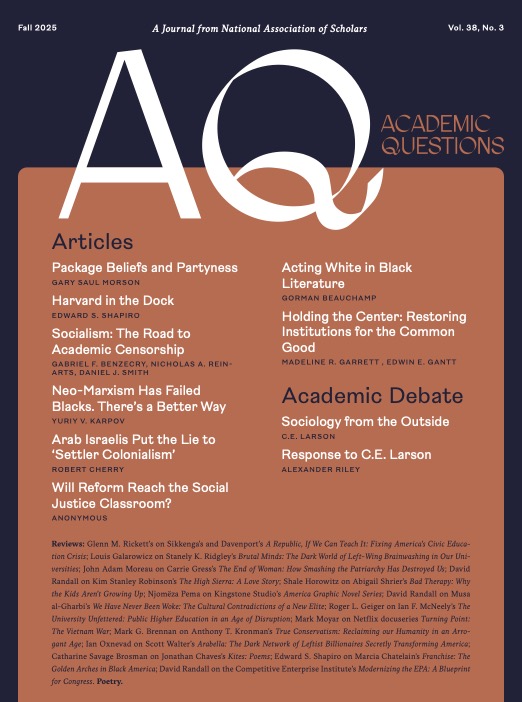
But this is no complaint. I have the privilege to read essays by some of the smartest and most original scholars in America putting forth their views in one of the few places where they need fear no attempt to restrain them. As it happens, this issue has a goodly collection of articles about unwelcome restraints, starting with Gary Saul Morson’s “Package Beliefs and Partyness.” Morson is best known as a scholar of the great Russian novelists, and his expertise is on display here, but not in the form of literary criticism. Rather, he draws from Russian literature accounts of how people are seduced into abandoning their common sense and their intellectual freedom to conform to a political platform.
It is a frailty not limited to Russia or the Soviet apparatus. The tendency of Americans to “outsource their opinions” to political leaders or seeming scientific authorities is, lamentably, all too common. We even have podcasters and myriad “influencers” who address our need to keep abreast of fashionable beliefs. Of course, the Russians in the time of orchestrated famines and show trials carried such self-abnegating obedience mush further, but we ought not to congratulate ourselves too much on our independence of mind. Slavish deference to the false edicts of Anthony Fauci and Francis Collins was just yesterday, and the George Floyd/BLM moral panic over “systemic racism” still lingers in the corridors of higher education. The readiness of otherwise rational people to credit the idea that children can change their sex is with us still. Morson’s fine dissection of the herd mentality is timely, and his observation that the various descents into group madness come together as a package (“package beliefs”) is a bull’s eye.
We again have an issue of Academic Questions that is overbrimming with articles, so I can’t comment on all of them. Edward S. Shapiro’s “Harvard in the Dock” offers commentary on the recent study that Harvard commissioned about antisemitism on its campus. There was no denying what had happened after the October 7, 2023 massacre in Israel when a substantial number of Harvard students ardently supported Hamas. The questions for the commission were whether that demonstration and the ensuing threats and attacks on Jewish students were a momentary aberration or evidence of a deeper and more pernicious ideology. Shapiro finds that the report flinches from the truth.
Robert Cherry’s article, “Arab Israelis Put the Lie to ‘Settler Colonialism,’” is another addition to our occasional series that began with our re-publication in 2018 of Bruce Gilley’s “The Case for Colonialism,” after the Third World Quarterly officially de-published it. Calling something “colonialist” had by that point become a verdict of moral iniquity. Gilley’s point was that at least some colonialism in Africa was hugely beneficial to the colonized. Given America’s own history of colonial enterprise, one might think that the term shouldn’t automatically denote oppression and misrule. But polemicists on the left never paused. Patrick Wolfe, an Australian historian, is usually credited with popularizing the idea that “settler colonialism” was and is an instrument of Western usurpation.
Cherry’s essay refutes the now widespread canard that Israel is an “apartheid state” in which the Arab residents suffer the debilities of an oppressed colonized people. I hesitated to publish it in AQ because it deals with controversies seemingly far from the American campus. Then I read Edward Shapiro’s essay on Harvard anti-Semitism and decided those controversies were not so far off at all.
“Will Reform reach the Social Justice Classroom?” appears in these pages without a byline. That’s not something we routinely do, though a fair number of our contributors have reasonable apprehensions about putting their names to public statements. Seth and I decided to make an exception in the spirit of protecting the author’s nephew from possible reprisal. The article itself deals with a fairly routine example of curricular bias. Since we are reassured so often that such things are imaginary, it is useful now and then to provide some specific instances.
Gorman Beauchamp returned to these pages with an excerpt from a forthcoming loner work about characters in black fiction who are accused of “acting white.” In this section, “Acting White in Black Literature,” Beauchamp contrasts Langston Hughes’ 1930 novel, Not Without Laughter, with Toni Morrison’s debut novel of 1970, The Bluest Eye. Both books feature a black woman who aspires to white manners, but the authors’ treatment of the character “stands at the polar opposite.” Hughes satirizes Tempy’s determination to “dress like white people, talk like white people, think like white people,” but credits her with deep loyalty to her family. Morrison demonizes her embodiment of the type as, in Beauchamp’s words, “ever more remorseless, ever more repellent.”
This issue offers an exchange between mathematics professor C.E. Larson and sociologist Alexander Riley on the utility of the whole field of sociology. Larson builds on his startled discovery of a student passing a college credit exam in sociology with virtually no preparation. He concludes that the field, unable to provide rigorous factual explanations of social phenomena, is essentially worthless. Riley admits that there is much wrong in sociology but thinks Larson is missing the bigger picture.
This issue’s florilegium of reviews includes Louis Galarowicz’s review of Stanley Ridgley’s Brutal Minds: The Dark Side of Left-Wing Brainwashing in Our Universities. The title does most of the work here, but I pluck this particular flower to draw attention to Louis, who I just recently promoted to NAS’s Director of Education Policy and Legal Affairs. He is a young man of keen intelligence and sterling character who I hope will make further appearances here.
I’d also like to draw attention to Shale Horowitz’s review of Abigail Shrier’s Bad Therapy: Why the Kids Aren’t Growing Up. The book is a sequel to her important 2020 work, Irreversible Damage: The Transgender Craze Seducing Our Daughters. Horowitz praises the new work as opening a wider window on our miserable “therapeutic culture.” I see this as a frontier for NAS. Saving higher education from a generation of students trained from an early age to revel in neurosis will be no easy thing.
Our poetry section in this issue is titled “Taking Sustenance, Then and Now,” and includes delicious poems by Ben Jonson, John Keats, Edward Fitzgarald, Eda St. Vincent Millay, and our own Catharine Brosman. To your health!
I should like to think that you will read this issue in its entirety, almost as though it were a copy of The Epoch Times, or at least a copy of Johnny Tremain. But time is limited and summer is waning, so feel free to wander in these pages and read what reaches out to you like the foison of the year.
Peter Wood is president of the National Association of Scholars and editor-in-chief of Academic Questions.
Photo by Ioann-Mark Kuznietsov on Unsplash