


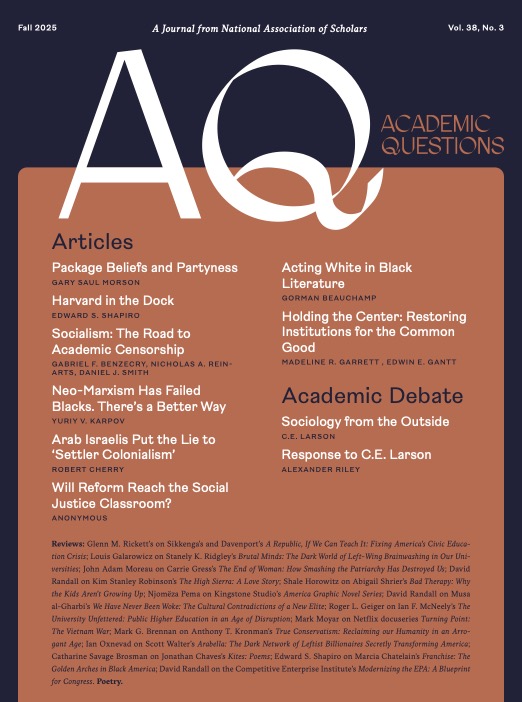
The End of Woman. How Smashing the Patriarchy Has Destroyed Us, Carrie Gress, Regnery Gateway, 2023, pp. 187, $29.99 hardcover, $17.89 paperback.
Barbara Amiel, a brainy accomplished Canadian writer, in Friends and Enemies: A Memoir writes feminism “has metastasized into a plague of boils on the body politic.” While Amiel confesses that “I don’t understand how we got here,” Carrie Gress offers a stark account of how “we got here,” with startling details and unflinching assertions. In a nutshell the book is about ruinous feminism. She says:
It is time for honest women to recognize that feminism has not been the boon for women that it has been presented as. To be sure, there have been many advances under feminism, such as laws against sex and pregnancy discrimination, custody law for mothers, and many social and economic opportunities. But to focus on these genuine improvements is to overlook the irreparable harm feminism has done to legions of women…. Feminism has likewise been awful for men, but it has been particularly awful for children, especially children of unmarried parents.... Feminism has left a trail of tears, misery, and confusion.
Gress is a Ph.D. with ten published books, including The Anti-Mary Exposed: Rescuing the Culture from Toxic Femininity. She has stated in an interview that she wrote the remarkable and vivid The End of Woman because there was so much about the subject that she could not address in the earlier book. She needed, she says, “to sift through history, piecing together the threads of this baffling story.” Gress is a fellow at the Ethics and Public Policy Center and a scholar at the Institute for Human Ecology at The Catholic University of America. She does not thunder and the tone is one of concern and compassion. Do a Youtube search and you find a well-spoken cordial professional. Gress sets the scene, writing:
This book is for all women, of any background, but especially for those who are struggling and feel frustrated that the future they were promised hasn’t materialized in their lives. It is for the women who have told me, “I know something isn’t quite right, but I can’t put my finger on the problem.” And it is for women who want to be women instead of whatever the culture is telling them to be. This is also a book for men who are tired and frustrated with the double standards that attack men’s vices, while heralding those of women; for men who love their wives and daughters, sisters and mothers—but have a hard time watching the women they love ruin their lives—or men who can’t figure out how to love them well; and for men who are just ready to give up on women entirely.
I think there is another group whom The End of Woman is for: the interested and sympathetic onlooker not directly touched by ruinous feminism but who, like Amiel, knows something is deeply wrong and wonders how we got here. The men in the above quote are the ones smashed, Gress makes clear, so much so that besides not challenging the tenets of ruinous feminism they buy in to it.
A definition of patrimony can go this way: Men hold dominant positions to which they are expected to bring credit. Further, they are to be a solid and loving rock in the family. The patriarchy of the feminism Gress writes about (she quotes a sociologist Sylvia Welby), is “a system of social structures and practices in which men dominate, oppress, and exploit women.”
The feminism Gress disparages holds that women should become more like men, independent and unconstrained by nature and that responsible, loving, and virtuous men should become obsolete; the family is the problem; the capacity for motherhood is not essential to being a female; that marriage and the family are evils and that a way to destroy patriarchy is to destroy monogamy, and the way to do this is to promote promiscuity, eroticism, prostitution, abortion, and homosexuality; abortion is a primary way to make men and women equal; lesbianism is a good and sensible way of life; social structures are the reasons for social problems, not individuals; sex is no longer a private matter but a public and political one; and through the centuries women have been victims of men and of society and that the history of women is one of drudgery and enslavement.
This feminist view of the world has been propagated perhaps most relentlessly by university departments of women’s and gender studies, where thousands of young women are treated to the idea that traditional families are the primary source of anti-female oppression. The response to Harrison Butker’s commencement address at Benedictine College in 2024 is evidence of the university’s centrality in perpetuating feminist ideology. Butker, the placekicker for the National Football League’s Kansas City Chiefs, made a presentation that was sober and dignified, and based mostly around his perception of ailments afflicting the Catholic Church and the difficulties of living a Catholic life. But with a warm and respectful enthusiasm, Butker praised women who choose to be homemakers and mothers. He also said women have been told "the most diabolical lies" regarding what is important about womanhood.
Needless to say, after the speech Butker, who received loud applause at the commencement, was treated to all kinds of vitriol by critics in the national press. "That so many people went ape," Gress said to me, "is not surprising. So much disgust is evidence of what I am saying in the book"
Gress discusses two waves of feminism, the first started by Mary Wollstonecraft (1759-1797), a British writer who wanted to reshape society by ridding it of male hierarchy, what she called “the tyranny of men.” Her most famous book is A Vindication of the Rights of Women. She also attacked the church and the military. Society, she held, was a system, as Gress puts it, “to keep women as delightful playthings, uneducated, and sexually available.”
In the nineteenth century other influential persons come onstage and in time, says Gress, “the tender relationship between mother and child begins to be erased from feminist rhetoric.” As Gress expands on later in the book, the lives of Wollstonecraft and many of her followers, their out of wedlock children, and others in the nineteenth century feminist movement were a mess. Some of these feminists were what Gress calls, adopting the term from feminist critic Phyllis Chesler, broken women. Life dealt them soiled cards. For example, Wollstonecraft’s vicious alcoholic father terrorized the family, beat and raped his wife, hanged the family dog in a fit of rage.
Gress dates the second wave of feminism from 1960 and notes that this wave coincides with the hurrying growth of television. Feminism’s march through institutions and society, says Gress, is due to the aggressive, skillful, and colorful popularizing of its messages. Newspapers, TV, radio, magazines, lecture halls, and the stage were constantly in their sights. The use of celebrities and fabricated statistics have also played roles. They assert their cause has the same validity as the black civil rights movement. These feminists, Gress says,
set the cultural agenda according to which we live today. These are the women who told us to hate the patriarchy and view men as the true enemies of womankind, who told us that ‘choice’ was better than life, convincing us that our children were an obstacle to our happiness, that the vulnerability that comes with giving life was the real enemy.
The second wave of feminism also coincides with the rise of mass higher education. Gress said in the interview that academia is awash with the ruinous feminist principles she attacks in the book, beginning particularly with the arrival of Women's Studies. "As just one example," she said. "women in MBA programs and in law schools are encouraged to freeze their eggs so they can delay motherhood as long as possible and are told they should focus solely on a career. Hookups are okay but dating isn't, and romantic relationships which are distracting are frowned upon."
Among the leaders of the second wave were Kate Millet, Simone de Beauvoir, Kate Weigand, Angela Davis, Adrienne Rich, Gloria Steinem, Andrea Dworkin, Shulamith Firestone, Valarie Solanas, and Betty Friedan, author of The Feminist Mystique, which sold three million copies. Friedan was adept at running with received ideas and had deft ways of saying things. “Men,” she wrote in a book review, “there’s a revolution cooking in your own kitchen—revolution of the forgotten female, who is finally waking up to the fact that she can produce things other than babies.” She called homemaking a “comfortable concentration camp.”
In Friedan’s dogma women can be free only if they are forced out of the home into the work force. After all, being at home is dissatisfying and women must be made to be dissatisfied. Gress quotes Friedan:
Perhaps it is only a sick or immature society that chooses to make women ‘housewives,’ not people. Perhaps it is only sick or immature men and women, unwilling to face the great challenges of society, who can retreat for long, without unbearable distress into that ... house and make it an end in itself.
Gress shines in her restrained handling of the matter of broken women. She agrees with Chesler, who wrote that “most of the women in the movement were incredibly broken by mental illness, sexual abuse, and drug abuse.” These are the “lost girls.” One can but cringe at the lot of Kate Millet, whose Sexual Politics sold 80,000 copies in its first month, August 1970, and went into seven more printings, becoming a manifesto of the movement. Episodes of mental illness were part of her train wreck of a life.
Likewise, writes Gress, the victims of ruinous feminism. They have their own train wrecks. “The madness, sadness, and brokenness of the lost girls,” she says, “was passed along to other women.” One key consequence is that “women who have experienced terrible male behavior, those who have been abused and abandoned, who are broken and wounded—the lost girls—are often incapable of discerning healthy male behavior.”
These women are conditioned by the tools of the movement. The tools are: Questioning feminism is a taboo; The role of scolding Mean Girl tactics is to cloud any information that might hurt the movement; Use humiliation and silencing to snuff out the opposition; Use fear in various ways, such as insisting that without abortion women have no future; Make women seem to be out of step with other women, The Tribe; Queen Bees, and many there are—(e.g. Jane Fonda, Elizabeth Warren, Whoopi Goldberg)—Use them all the time.
The cover of the book is a cubist illustration of a woman with two faces. One face is alert and sensitive, the other is sad and reflective. In the interview Gress said that she means precisely what the word she uses to describe the harm done women means—irreparable, not to be repaired or rectified. Millions of women, Gress said, “embraced what I call the fracturing of what it means to be a woman, making a woman into something she is not meant to be.” Feminism, Gress argues, asked the wrong questions and got the wrong answers. Feminism wants women to be happy “either as men or by themselves without men. The right question is how we help women as women in relationship to husbands and children, instead of making them into what we were never meant to be.”
Although these are the lost ones, Gress says she finds that some young men and women have “become suspicious” of ruinous feminism and reject it. That alert and sensitive face on the cover could stand for those people. The sad and reflective face can stand for those who have been harmed by ruinous feminism. These women, says Gress, are of all faiths and no faith. In the interview she said that women have told her the book was a wake-up call, in some instances it has saved marriages. Gress is now writing a book on why Christianity and feminism are incompatible.
Gress says that “almost every woman who subscribes to feminism does so because she truly wants to help women.” But the source of the irreparable harm, she argues, is in ignoring a woman’s natural vulnerability, and “by making us cheap imitations of men and ignoring our womanhood.” Ruinous feminism, Gress says, asserts what is good for women is androgyny—combining men and women into a single individual. This is a fix which can’t fix anything. Instead, this approach “has erased women one slow step at a time.” The goals and methods of feminism leave women “miserable, unhealthy, and wondering what we did wrong.”
Feminism, Gress says, presented the wrong answer to what helps women have better, happier lives than heretofore. What really helps women, she writes, is to “let women be women.” She calls this an ‘incredible challenge when the whole context within which we have thought of ourselves is competition with men.” This is a race to the bottom.
In time we will know if ruinous feminism has won the day and will run on in the present cultural turmoil. Is it too deeply embedded, or will it burn out? Gress does not offer a war program against the situation. For now, says Gress, it is the default position for a significant portion of society. It has gone from a fringe movement “to a belief system accepted by a majority of Western women today.”
A sympathetic reader will probably be of one mind with reflective parts of the book wherein Gress says that among answers is embracing the notion of the beauty of motherhood and sanctity of the home. Women who behave badly: Knock if off! And, she says, end the vilification of men. She writes that unless women abandon an envy-driven identity, “we women will continue to rage, resent, destroy, and demean those we were made to love and care for.”
I don’t flatter myself that I have done justice to this brisk handsomely written book. Perhaps a worthy atonement for my shortcoming is to say, Madam and Sir Reader, that beyond what I have told you there awaits a packed boxcar of additional persons, subjects, statistics, history, analysis, and ideas which make for rewarding and compelling reading.
John Adam Moreau, a history Ph.D. from the University of Virginia, has been a longtime reporter and editor for major daily newspapers; jaxm_@bellsouth.net. He is the author of Randolph Bourne, Legend and Reality (Public Affairs, 1966) and of published essays on such subjects as Huey Long, Francisco de Miranda, and Heywood Broun. He last appeared in AQ in spring of 2025 with “A Founder Worth the Time,” a review of Bradley J. Birzer’s American Cicero: The Life of Charles Carroll (2024).
Photo by Jiratip on Adobe Stock