


Executive Summary
The Massachusetts Institute of Technology (MIT) is among the most beloved institutions of scientific education and research in the world. Despite its long-standing commitment to scientific education and research, MIT has fallen victim to a destructive ideology that has steadily infiltrated the institution over the past several decades—an ideology hidden under the banners of noble ideals such as Diversity, Inclusivity, Equity, and so-called “Anti-racism.”
This report traces the history of DEI initiatives at MIT over the past three decades and illustrates how collegial discussions surrounding affirmative action programs and policies transformed into an authoritarian regime. What began, and is still often erroneously believed to be, a movement meant to foster inclusion has evolved into one that stands directly opposed to scientific inquiry, freedom of speech, and democratic norms. This movement appears to have recently bifurcated into two distinct factions: one that promotes radical gender ideology and sex-based identity politics under the banner of “Queer Theory,” and another that celebrates the mass slaughter of Jews and endorses further political violence under the banners of “Liberation” and “Decolonization.”
In addition to the history of DEI at MIT, this report also explains succinctly DEI’s ideological nature. We expose the way in which DEI is fundamentally opposed to science, why it is naturally authoritarian and censorial, and how MIT administrators have long denied this nature despite the facts and evidence to the contrary. The Massachusetts Institute of Technology, once a pillar of scientific education and research, has instead become a battleground for ideological conformity, where dissenting views are far too often met with hostility, and dissenters are ostracized.
Examples of DEI’s true nature abound at MIT, from porn stars and Communist leaders invited to speak at events, to a student arguing for political violence, and much more. Many remain hopeful that this era is nearing an end, and that DEI is on the decline at MIT and elsewhere. Certain developments do suggest as much, such as name changes away from “Diversity” and “Equity” and MIT’s abandoning of the practice of “Diversity Statements.” Yet our analysis suggests that these efforts may be signs of concealment, rather than recovery, and that a resurgence of DEI will occur if the advocates and ideologues are not removed from MIT’s community. These individuals either fully understand and approve of the radical objectives of DEI or are incapable of perceiving that radicalism accurately. In either case, their continued presence at MIT is incompatible with the principles of scientific inquiry, free speech, and academic freedom.
We conclude with a set of additional recommendations for concerned members of the MIT community, such as familiarizing themselves with DEI’s underlying ideology on a deeper level and adopting the MIT Free Speech Alliances’ recommendations to bolster free speech and civil discourse throughout the institute. MIT is at a crossroads, and can choose to reaffirm its commitment to scientific education and research, or it can sacrifice its reputation and intellectual integrity in favor of ideological orthodoxy. The future of MIT depends on the willingness of its community to confront DEI and restore MIT’s reputation and rank among those institutions dedicated to scientific inquiry, the pursuit of truth, and freedom of expression.
Introduction
During our visit to the museum of the Massachusetts Institute of Technology in April 2024, we saw much of what we expected to see: a solar-powered car; a typing test that can predict Alzheimer’s disease; and the MIT campus mapped out in the video game Minecraft. We also saw what few would likely believe had we not bothered to take photos and videos, such as an exhibit in which an artist used a strap-on dildo as a paintbrush.
The exhibit, In Posse: “Female” Semen and Other Acts of Resistance, a video series paired with associated artifacts about a project that spanned nearly two decades. The video’s narrator describes the project as “performative research,” a form of research that “is neither true nor false” and “ultimately queer.” As the narrator explains, while a blurred-out video of a man masturbating and ejaculating plays on repeat in the background:
Things that are queer also have the potential to be radical. In this way, what I am terming performative research, specifically art and or science which changes something in society through its existence, is also a kind of activism. By going on these journeys, we are rejecting the status quo. We are protesting the past, taking control over our present, and optimistically envisaging a future in which existing hierarchies have been undermined. We are fucking the patriarchy.1
One might hope that this exhibit was a mistake, or an oversight of the museum’s curators or of MIT’s administrators. The truth is that In Posse is but one data point in a well-documented trend of an authoritarian, censorious, and anti-scientific ideology’s imposition upon American higher education. The Massachusetts Institute of Technology, a crown jewel in the Western world’s educational institutions of science, technology, engineering, and mathematics (STEM), has fallen prey to this ideology, which advocates erroneously believe to be not only benign but also beneficial, and introduced it to the institute under the banners of a few seemingly noble ideals: Diversity, Inclusivity, and Equity.
Fortunately, it appears that MIT’s institutional immune system has begun working to fight this ideological cancer. Yet if we wish to prevent this disease from recurring, we must have a proper diagnosis of how it first spread throughout MIT. This report surveys the history of Diversity, Equity, and Inclusion (DEI) ideology at MIT, discusses recent major events that provide evidence of DEI’s ideological capture of MIT, and analyzes the even more recent events that suggest partial recovery. We conclude with recommendations and resources for how MIT’s stakeholders can rid their institution of DEI ideology, and restore and reinforce MIT’s reputation as a premier institute of scientific education and research.
Historic Overview
It took a generation for DEI advocates to capture MIT. The process may be broken into three major stages: Infection (mid-1990s to 2008), Incubation (2008–2020), and Infestation (2020 to roughly the present day). We discuss each individually in the sub-sections below:
Infection (mid–1990s to 2008)
In the mid–1990s, a group of MIT faculty, staff, and students worked with Dr. Clarence G. Williams, a special assistant to MIT’s then-President, to produce a short video series about race relations at MIT. The producers interviewed groups of black, white, Asian, and Hispanic students about their perceptions, and then brought the groups together a few years later to discuss their views once more. MIT preserves these videos on its TechTV website.
White and black students alike spoke about the problems created by affirmative action. One white female student stated plainly: “I think [affirmative action] actually opposes a society where different races and different cultures respect each other, because if I think I’m more worthy to be here than someone else, then I’m probably not going to treat them as an equal.” Many of the white students agreed and one lamented that affirmative action allowed minorities to continue to be regarded as inferior. The black students, for their part, spoke of the resentment they often encountered from students of other races, and one explained that teachers and teaching assistants appeared to have lower expectations of him, despite his capabilities.2
Rather than regard these statements as preliminary warnings, MIT administrators continued with this early form of DEI policies. In May 2004, the Faculty Policy Committee released a statement on the representation of minorities in the faculty and in the graduate student body. It considered “diversity” to be an issue of “strategic importance to MIT.” The statement included a list of recommendations, such as to require explanations for each minority-candidate decision and to track the progress of minority students in science, technology, and in the social sciences.3 Roughly one year later, in 2005, MIT began to track its racial composition and make the results public. The institute’s collection of racial data occurred long before this—based on a student’s comment about the use of the tutoring center in the aforementioned video series—but 2005 marked the beginning of the systematic collection and presentation of racial data that continues to this day.4
In February 2008, MIT’s then-President, Susan Hockfield, gave a speech at an annual breakfast celebration meant to honor Dr. Martin Luther King, Jr.. Her speech was titled “Diversity and Inclusion: Building a Solution Worthy of MIT.” Hockfield announced that MIT had admitted the most “diverse” freshman class in its long history, and that the institute would soon hold its first “Diversity Leadership Congress.” Wesley Haris, the newly appointed Associate Provost for Faculty Equity, remarked: “I have not seen MIT with this level of activity directed toward… transformational behavior when it comes to faculty of color in my 30-odd years of serving here in this community.”5
President Hockfield held the first Diversity Leadership Congress in November of 2008, and the spread of DEI ideology increased in the years thereafter.6 The infection of DEI ideology first touched MIT through affirmative action programs, but a clear shift occurred in 2008, possibly due to the success of identity politics—whether real or perceived—in President Barack Obama’s campaign and election. The shift also may have occurred as a result of MIT administrators’ desires to achieve “peer similarity” with comparable educational institutions, a frequently stated rationale for DEI adoption.
Incubation (2008–2020)
In January 2010, MIT’s Initiative for Faculty Race and Diversity finalized a report on the institute’s “underrepresented minorities” (usually a euphemism for blacks, Hispanics, and American Indians). The Initiative began its research in 2007, under the direction of MIT’s then-Provost, Rafael Reif, who later became MIT’s President. The authors of the report noted that “There is a tension around what minority faculty perceive as the non-minority view that the inclusion of diverse groups decreases quality and level of excellence. These issues become difficult to address because of a general discomfort in openly discussing matters of race in the academic settings of MIT.”7
Once again, rather than regard this tension as a preliminary warning, MIT continued with its DEI efforts. The first institutional websites to promote DEI ideology soon began to appear, such as the Office of Minority Education (beginning around May 2012) and the Institute Community & Equity Office (beginning around May 2015).8 In response to the then-recent campus protests at the University of Missouri and Yale University, along with the controversial shooting of Michael Brown, MIT’s Black Graduate Student Association (BGSA) made recommendations to MIT’s administration in December 2015. The BGSA sought to increase the number of “underrepresented” minority graduate students (with a particular emphasis on black students), to require “implicit bias training” for all laboratory personnel, and to require “diversity training” for all new graduate students. Now serving as MIT’s President, Rafael Reif accepted the BGSA’s recommendations, presented them to the Academic Council, and shared them publicly.9
Infestation (2020 to roughly the present day)
Between 2015 to 2020, DEI ideology quietly ascended in prominence at MIT. The death of George Floyd and the Black Lives Matter (BLM) riots in the summer of 2020 served as the pretext for a renewed focus on DEI initiatives (and, by extension, ideology) throughout higher education. MIT’s administrators, however, had already been working on entrenching DEI programs and ideology throughout the institute. In February 2020, for example, months before Floyd’s death and the BLM riots, MIT administrators wrote to the community regarding actions it would take following the release of the National Academy of Sciences, Engineering, and Medicine’s (NASEM’s) report on sexual and gender harassment of women in academia. Specifically, administrators explained that “[e]ach of MIT’s five schools and the College of Computing will appoint senior staff to advance diversity, equity, inclusion, and community efforts, and that they would establish “more targeted education” to those ends.10
Early signs of censorship began cropping up shortly thereafter. Daniel Patrick Moloney, for example, who served as MIT’s Catholic chaplain, commented that George Floyd “had not lived a virtuous life” and questioned if Floyd’s death was the result of racial prejudice. Floyd’s criminal history was indeed extensive, and no evidence has surfaced in the years since that would suggest that Floyd’s death under police restraint was racially motivated.11 Despite these facts, Suzy Nelson, the Vice Chancellor and Dean of Student Life for MIT, felt it was appropriate to send an email to the students calling Maloney’s message “deeply disturbing,” and Father Maloney resigned his position.12
A month later, in July, President Reif wrote to students about his “efforts to address systemic racism at MIT.” Reif mentioned a recent student petition to “Support Black Lives at MIT” that demanded the integration of DEI policies and training, as well as the completion of the Black Graduate Student Association’s 2015 recommendations. Reif promised new funding for “anti-racist” research and minority-specific scholarships, and reminded the MIT community that new senior administrators for DEI would soon be hired.13
In October, a new “diversity series” was begun by various engineering departments, featuring none other than Angela Davis, a former leader of the Communist Party USA (CPUSA). CPUSA was an organization that worked closely and clandestinely with the Soviet KGB to undermine the United States government through propaganda, terrorism, and antagonism of racial relations.14 Despite this history, Davis was invited as a keynote speaker. Paula Hammon, head of the Department of Chemical Engineering, said that “[Davis’s] work has left an imprint on me personally. … I look forward to continuing our work to foster inclusion and equity in our MIT community.”15
The hysteria did not fade as fast as many had quietly hoped. MIT had announced in February 2020 that it would hire six new deans to promote DEI; by June 2021 it had done so. John Dozier, MIT’s Institute Community and Equity Officer, noted that the institute would be hiring even more DEI administrators and establishing a senior DEI position in the Office of the Vice President for Research.16
The DEI bureaucracy had grown greatly in size. Now possessed of eyes and ears throughout the institute, the DEI bureaucracy began to reveal its truly censorious nature. In September 2021, in one of the most infamous cases of DEI-related censorship, MIT rescinded Dorian Abbot’s invitation and canceled that year’s Carlson Lecture. One month prior, much to the displeasure of MIT’s DEI officers, Abbot and his co-author Ivan Marinovic had written critically of DEI in Newsweek,.17 Their Newsweek article was enough to get Abbot disinvited from MIT.
MIT’s provost, Martin Schmidt, wrote to the community to explain that Abbot’s “views on diversity, equity, and inclusion and manner of presenting them were overshadowing the purpose and spirit of the Carlson Lecture.”18 Schmidt’s words failed to quell community outrage, so President Reif penned another letter shortly thereafter in an attempt to assure the MIT community that “freedom of expression is a fundamental value of the Institute.” What Reif did not realize—or simply refused to admit—is that freedom of expression is antithetical to DEI’s core ideology (see the section below).19
Like Schmidt’s, Reif’s words did little to reassure the MIT community. A faculty poll held on October 27, 2021 asked participants: “Do you feel on an everyday basis that your voice, or the voices of your colleagues are constrained at MIT?” 52% agreed. Pollsters also asked: “Are you worried given the current atmosphere in society that your voice or your colleagues' voices are increasingly in jeopardy?” 77% agreed. At another faculty forum held on November 3, these questions were asked again. 60% agreed with the first question, and 79% agreed with the second—an 8% and 2% increase, respectively.20
For many, Abbot’s disinvitation—which became known as the “Abbot Affair”—proved too much. In response, two wealthy MIT alumni vowed to cease their donations to the institute.21 A satirical and anonymously-run newspaper, The Babbling Beaver, was created, as was the MIT Free Speech Alliance (MSFA), which quickly grew to over 800 members and received a half-million dollar grant to continue its work.22 During this timeframe, from the Abbot Affair in September 2021 to the MFSA’s surge in membership and financial profile by May 2022, MIT slightly eased its DEI policies. In May 2022, MIT’s leadership also reinstated its SAT / ACT requirement, although it tried to argue that the decision was part of MIT’s DEI advocacy. Most DEI advocates want standardized tests eliminated, often decrying the practice as racist because it has a “disparate impact” upon “under-represented minorities”.23
In early September 2022, MIT’s Ad Hoc Working Group on Free Expression—created after the Abbot Affair to address free speech at MIT—released its report. The authors of the report wrote that:
Critics of self-censorship seem to have in mind a campus climate in which certain voices (prototypically conservative ones) are forced into the closet for fear of the consequences of speaking out. In particular, some members of our community (and commentators outside it) argue that diversity, equity, and inclusion programs—which seek to ensure that minorities are effectively incorporated into the life of an education institution—have given rise to a censorial, even authoritarian culture that brooks no disagreement with the official policies of the university.
The analogy is not meaningful between authoritarianism and the movement in favor of institutionalizing DEI policies on college campuses generally—and certainly not at MIT.24
As we will show in the next section, this statement was ignorant or disingenuous. Tellingly, shortly after the group’s findings were published, MIT officially adopted a strategic action plan for DEI, altered from the five-year plan first presented in March 2021, that required the exact censorial, authoritarian campus climate that the Working Group on Free Expression denied existed. Take, for example, the following points of the plan that demand faculty members not only comply, but also actively support DEI programming (referred to here as “belonging, achievement, and composition”) to advance in their careers and the DEI certifications required for hiring / admissions decision makers:
Develop and share across the Institute standards for annual performance reviews of staff that acknowledge and support contributions to belonging, achievement, and composition at MIT.
Review and evaluate existing tenure and promotion criteria and revise them, as necessary, to incentivize service contributions that include belonging, achievement, and composition.
Create a certification process focused on the relationships between diversity, community, and excellence for all faculty participating in graduate admissions decisions
Create a certification process focused on the relationships between diversity, community, and excellence for all MIT principal investigators who make postdoc and research staff hiring decisions
Create a certification process focused on the relationships between diversity, community, and excellence for all hiring managers and staff who participate in staff hiring decisions.
Create a certification process focused on the relationships between diversity, community, and excellence for all faculty participating in faculty hiring decisions.25
Self-censorship among MIT faculty did not subside in the months thereafter. As the Foundation for Individual Rights and Expression reported about MIT in early 2023: “When presented with a definition of self-censorship and then asked if they were more or less likely to self-censor on campus today compared to before the start of 2020, 40% of faculty said they are “more” or “much more” likely to do so. In contrast, only 5% were “less” or “much less” likely to do so.”26
Summary
It took roughly a generation, a full 30 years, for DEI advocates to capture MIT. What began in the mid–1990s as collegial discourse about race relations and affirmative action was slowly transformed into a censorial, identitarian, and authoritarian ideology wholly antithetical to scientific inquiry, academic freedom, and other civil liberties. Many observers may still be holding out hope that such recent events are the latest iteration of radical politics and student “hacks” (i.e. pranks), citing figures such as MIT Professor Noam Chomsky and events such as the placing of a police car on top of MIT’s dome, but this is folly.27 A cadre of advocates and officers came to demand that people ignore the evidence readily apparent to their eyes and ears, lest they have their reputations and livelihoods threatened. Such radical politics are enforced, and students now chant for “Intifada,” violent revolution, against Jews and other “oppressors.” When we conducted a survey in early 2024 to see where DEI was not present at MIT, we failed to find it. But documenting how the Institute became infected, and the extent of that infection, is only a first step. MIT’s stakeholders must understand the threat DEI poses in order to fight back.
DEI Ideology at MIT
Diversity, equity, inclusion, and so-called “anti-racism” programs have received serious criticism in recent years, and for good reason. Many well-intentioned people, however, still erroneously believe these buzzwords to refer to benign concepts and continue to support DEI. The truth is that DEI and “anti-racism” refer to an amalgam of anti-scientific, censorial, and authoritarian ideologies—mainly variations of postmodernism and critical theory. To make matters worse, those involved in STEM education and research, such as the MIT community, make easy prey for these radicals. DEI ideology originates in political philosophy rather than science, which often leaves STEM educators and researchers at a significant rhetorical disadvantage when they try to criticise DEI. Would-be critics must debate silver-tongued devils while trying to convince a scientific audience that is rarely conversant with these issues.
This section briefly explains DEI ideology, its anti-scientific, censorial, and authoritarian nature, and provides examples of DEI’s true radicalism within the MIT community. We conclude with a set of resources for MIT’s stakeholders to learn more about DEI ideology, its origins, and rarer variations (such as “fat liberation studies”) that we do not cover here.
DEI Ideology as Anti-Science
Adherents of DEI ideology are radically skeptical about the nature of truth and are committed to what is known as “cultural constructivism.” The scientific skeptic and the radical skeptic differ considerably. The scientific skeptic doubts the validity of a truth claim and seeks to prove—through means of experimentation and subsequent data analysis—that the truth claim is, in fact, false. The radical skeptic, in contrast, assumes that all truth claims are merely constructs of the culture asserting the claim as true (hence the term cultural constructivism) and that no objective truth exists between cultures. This concept is known as the “postmodern knowledge principle” and stands in direct opposition to science.28
In fact, the DEI advocate would argue that science itself exists not as a procedure to investigate the truth of objective nature—as scientists and the public commonly understand science to be—but as a cultural institution constructed to increase the power of a particular group, most often white, heterosexual men. The DEI advocate would also argue that the scientific method is only a method of a single culture, rather than universally true, and that it also was “culturally constructed” for the benefit of white, heterosexual men.29
The belief that the scientific method is a culturally constructed method of white, heterosexual men explains why MIT’s Consortium for Graduate Studies in Gender, Culture, Women, and Sexuality recently offered a course on “Feminist, Queer, and Indigenous Methods.” As the course description explains: “While academic inquiry and research from the West / global north has been responsible for some of civilization’s greatest achievements, it has also been a powerful tool of domination, oppression and erasure.” This course explores what MIT administrators call “non-normative research methodologies.”30
In another example, MIT held a roundtable discussion on “Erotic Methods,” explaining that in “queer and trans studies, BDSM,31 [sex] dungeons, public sex, erotic vomiting, and other dissident acts are crucial venues for re-organizing hegemonic formations of gender, class, and race.”32
Fig. 2 –Screenshot of the MIT’s Web Page Advertising Their Roundtable on “Erotic Methods”

While not hosted by the institute itself, MIT’s GCWS helped advertise a course at neighboring Boston University called “A Queerness of Biblical Proportions: Queer Theory and Biblical Interpretation.” We have chosen to omit the poster for this course due to its explicit nature, as the advertisement features the image of a man drinking the milk of a pregnant woman directly from her breast. The course description demonstrates the postmodern knowledge principle by asking, “What happens to biblical texts when queer readers explore them?” Note that the question is not asking how biblical texts may be interpreted, but asking how the texts will actually change when a new culture (i.e. a queer culture) constructs truth claims about them.33
The description provided by the author of the In Posse exhibit at the MIT museum, first mentioned in the introduction of this report, also bears repeating. Her notion of “performative research” that is “ultimately queer” captures the preeminence of political activism within DEI ideology. It also captures what can only be described as the rage of DEI ideologues against what is perceived to be the dominant culture, and against “normative” methods such as the institution of science and the scientific method itself.
In this way, what I am terming performative research, specifically art and or science which changes something in society through its existence, is also a kind of activism. By going on these journeys, we are rejecting the status quo. We are protesting the past, taking control over our present, and optimistically envisaging a future in which existing hierarchies have been undermined. We are fucking the patriarchy.34
Of course, none of these “non-normative” or “queer” methods are actual methods of scientific inquiry, nor can they further the scientific careers of the minorities who would supposedly benefit by practicing these methods. The periodic table does not shift if the chemist is male or female. A physicist’s sexual orientation does not change the electromagnetic force. The skin color of a biologist or his ancestry will not change the fact that the mitochondria is the powerhouse of the cell. Nevertheless, the DEI ideologue would make such statements. DEI ideology stands in direct opposition to science and scientific inquiry.
DEI Ideology as Censorial and Authoritarian
Words and phrases such as “domination,” “oppression,” “erasure,” “hegemonic,” and “undermining hierarchies” appear repeatedly within the aforementioned descriptions. These are all indicators of a concept known as the “postmodern political principle,” which holds that systems of power construct culture and society at large. These systems of power, hierarchies, and hegemonies, decide what can be known—as, per the postmodern knowledge principle, knowledge is a cultural construct—and how it can be known, such as through the use of language.35
The DEI ideologue would regard words, and even numbers (as mathematics is the language of science), as tools used to uphold or undermine a cultural paradigm—the hegemonic system of power—-and its cultural “ways of knowing.” Since DEI also states that liberation from unjust power (arbitrarily defined) is imperative, advocates of DEI ideology must censor, as any attempt to question another’s beliefs (i.e., truth claims) from a position of “power” (however power is defined) is viewed as the “domination,” “oppression,” and “erasure” of that culture and its “ways of knowing.” The imperatives of ‘liberation’ cannot allow such truth claims.36
For this same reason DEI ideology is necessarily authoritarian. Since DEI ideology views the world as one of constant competition between identity groups for “power” over each other, the only way to ensure peace is to tear down the “hegemonic” and “oppressive” system(s) of power and bring those currently powerful groups down to equal footing with all other groups. This end-state is called “Equity.” Of course, in order to ensure that this state of perpetual equality is maintained indefinitely, and that no group challenges the others (which they are inclined to do, as the first axiom to be adopted is to see the world as an endless identity-based power struggle), the DEI ideologues must establish a government with the authority and capability to control the distribution of resources and liberties permitted to each group.
While their end goal is quite literally impossible, as there are effectively an infinite number of groups and ways in which inequality might manifest between them, the mere attempt to achieve this goal requires perpetual totalitarian government. DEI advocates are aware of this corollary, and have advocated explicitly for just such a government. Take, for example, the “Department of Antiracism” proposed by Ibram X. Kendi, author of the bestselling book How to Be an Antiracist, which became a staple in DEI programs. Kendi proposes that we pass a constitutional amendment that:
“would establish and permanently fund the Department of Anti-racism (DOA) comprised of formally trained experts on racism and no political appointees. The DOA would be responsible for preclearing all local, state and federal public policies to ensure they won’t yield racial inequity, monitor those policies, investigate private racist policies when racial inequity surfaces, and monitor public officials for expressions of racist ideas. The DOA would be empowered with disciplinary tools to wield over and against policymakers and public officials who do not voluntarily change their racist policy and ideas.”37
A government agency with no political appointees is one that would not be under the control of the President or Congress. If the agency is responsible for preclearing all local, state, and federal public policies, it would exceed in its power not only the other executive agencies, but also the judicial and legislative branches of the federal government, as well as those governments at the state and local levels. In addition, if the agency is tasked with investigating “private racist policies,” which the agency alone is allowed to define, then individual rights such as freedom of speech, right to privacy, and right to property are all in jeopardy. If the agency is allowed to “monitor public officials” and have “disciplinary tools to wield over and against policymakers” then the right of the people to elect their representatives, democracy itself, is effectively ended.
Keeping in mind that Kendi is perhaps the most prominent advocate of “Anti-Racist” and DEI programs, it is worth repeating the claim of MIT’s Ad Hoc Working Group on Free Expression: “The analogy is not meaningful between authoritarianism and the movement in favor of institutionalizing DEI policies on college campuses generally—and certainly not at MIT.”38 This statement is at best naive.
Many members of MIT’s DEI bureaucracy support Kendi and the censorial, authoritarian, and identity- / power-obsessed philosophy he stands for. Consider, for example, Kuheli Dutt’s “Race and Racism in the Geosciences,” which argues that “disregarding race in a setting with a strong imbalance of power—as is the case in many US geoscience departments—reinforces race being viewed by default from a perspective of being White.”39 MIT’s School of Science later hired Dutt as Assistant Dean for DEI, and MIT administrators celebrated the fact that her article was “Nature Geoscience’s top-most accessed paper that year, with more than 66,000 views.”40 Consider, too, an article by Melissa Nobles, MIT’s Chancellor, on the “journey to help decolonize research” and help science—the cultural institution, not the investigator—overcome its “racist legacy.”41 The intellectual commitments of MIT’s DEI personnel are inseparable from the authoritarian DEI policies they worked to impose on MIT.
DEI ideology has infected all of MIT, and not just its museum, consortium for gender studies, and senior administration. MIT’s Division of Student Life, for example, which oversees Housing & Residential Services, promoted DEI ideology in various ways, such as through their Social Justice Programming & Cross-Cultural Engagement (SPXCE) which hosted a “Diversity Orientation Program” for all new students.42 Since first-year students are required to live on campus, MIT’s Division of Student Life in recent years has likely imposed DEI ideology on nearly every MIT undergraduate student.43
The School of Humanities, Arts, and Social Sciences (SHASS) has likely imposed DEI ideology also, considering that SHASS seems to be the epicenter of DEI ideology in MIT’s academics, and all undergraduate students are required to take SHASS courses, many of which are laced with DEI ideology.44 In fact, SHASS once listed over 100 courses on “diversity-related” issues. Some of these courses appeared benign, such as Global Chinese Food (21G.045), Music of Africa (21M.293), and European Politics (17.561). Many others, however, clearly incorporate DEI ideology.45 Whether MIT undergrads are able to avoid taking these courses or not, and if those students have suffered in the job market or in graduate school applications for having taken / abstained from taking such courses is unknown, but the fact remains that such ideologically predetermined courses exist, and should not. Examples of these DEI-related courses, along with excerpts from their course descriptions, include:
The Black Radical Tradition in America (21H.229)
“Focuses on American history from the African-American perspective. Includes alternative visions of the nation’s future, and definitions of its progress, that have called for a fundamental restructuring of political, economic and social relations.”46
Gender, Race, and Environmental Justice (21A.407J)
“Provides an introduction to the analysis of gender in science, technology, and environmental politics from a global perspective. Familiarizes students with central objects, questions, and methods in the field. Examines existent critiques of the racial, sexual and environmental politics at stake in techno-scientific cultures.”47
New Culture of Gender: Queer France (21G.325J / WGS.233J)
“Addresses the place of contemporary queer identities in French discourse. Discusses the new generation of queer authors and their principal concerns. Introduces students to the main classical references of queer subcultures… Examines current debates on post-colonial and globalized queer identities through essays, songs, movies, and novels.”48
Identities and Intersections: Queer Literatures (WGS.245)
“Focuses on LGBT literature from the mid-19 century to the present, with an emphasis on fiction and poetry. In particular, analyzes how LGBT identities and their literary representations have changed over time.”49
Language and Power (24.252)
“Explores topics at the intersection of philosophy of language and social / political philosophy. Topics may include linguistic harm, free speech, speech in non-cooperative contexts (lying, insincerity, antagonistic interlocutors), propaganda, pejoratives, and the relationship of language to features of the social world (race, gender, ideology).”50
Science Activism: Gender, Race, and Power (WGS.160J)
“Examines the role scientists have played as activists in social movements in the US following World War II. Themes include scientific responsibility and social justice… the significance of race and gender… and concerns about genetic engineering, gender equality, intersectional feminism, and student activism at MIT.”51
Intersectional Feminist Memoir (WGS.238J)
“Explores the memoir genre through a feminist intersectional lens, looking at the ways in which feminist writers ground personal experience within a complex understanding of race, gender, sexuality, class, ethnicity, immigration status / nationality, and dis/ablity.”52
MIT’s Library also promotes DEI ideology through its selected collection of “Racial Justice and Anti-Racism” resources, featuring authors such as the aforementioned Ibram X. Kendi and former Communist party leader Angela Davis. What one cannot find on MIT’s list are the many black authors and commentators who do not subscribe to DEI ideology. These authors and commentators include people such as Glenn Loury, John McWhorter, Africa Brooke, Thomas Sowell, Obianuju Ekeocha, Clarence Thomas, Amala Ekpunobi, Amir Odom, Coleman Hughes, Daryl Davis, Sheena Mason, Erec Smith, Michael DC Bowen, LaToya Smith, Ayaan Hirsi Ali, Magatte Wade, Roland Fryer, Ian Rowe, and Chloé Valdary, to name just a few. Even the works of Martin Luther King Jr., who is likely the most iconic and recognizable figure of the Civil Rights movement, are not included on MIT’s list.53
DEI ideology does not and cannot advance MIT’s mission to “best serve the nation and the world.”54 This fact has not stopped DEI ideology’s intrusion into MIT and the sciences more broadly, despite the ideology being entirely anti-scientific, censorial, and authoritarian in nature. Looking back at the history of MIT, it is clear that the institute’s early diversity initiatives did not begin with the radicalism now so clearly apparent. What began in the 1990s as affirmative action policies and collegial discourse about race relations transformed into a movement antithetical to everything that MIT stands for.
Much more can be said about DEI ideology and its various forms, such as post-colonialism / decolonization, fat liberation studies, and so-called “research justice.” We strongly recommend that MIT’s stakeholders read Helen Pluckrose and James Lindsay’s book Cynical Theories, which very competently narrates the history of DEI ideology and analyzes the harm it can cause when it leaves the academy and makes its way into the broader society. We also recommend the following resources for additional information:
Essays and Articles:
- Peter Wood, “Regime Change: Repelling the DEI Assault on Higher Education,” National Association of Scholars (June 13, 2022).
- Jordan Peterson, “Equity: When the Left Goes Too Far,” jordanbpeterson.com.
- J Scott Turner, “The Brainworms Come For Big Science,” The American Mind (January 25, 2021).
- Mason Goad, “KGB Documents Show the Secret History of Ibram X. Kendi’s ‘Antiracist’ Movement,” Minding the Campus (August 29, 2022).
Books and Documentaries:
- Diversity, Inclusion, Equity and the Threat to Academic Freedom, edited by Martin López-Corredoira, Tom Todd, and Erik J. Olsson (Exeter, UK: Imprint Academic, 2022).
- Gad Saad, The Parasitic Mind: How Infectious Ideas are Killing Common Sense (Washington, DC: Regnery, 2020).
- Peter Boghossian and Lyell Asher, Why Colleges are Becoming Cults, YouTube (2022).
Signs of Recovery? Or Concealment?
Since roughly the spring of 2024, and especially after the election of President Trump in November of that year, the grip that DEI ideology has held on MIT, and on higher education more broadly, appears to have loosened. Even so, these positive signs raise a question: are these really signs of recovery, or are MIT administrators just concealing their DEI efforts, ready to start openly advocating for these policies again the moment that the public and policy makers stop paying attention to the issue?
The positive signs are numerous. In May 2024, for example, MIT’s administrators announced that they would stop asking for “Diversity Statements” from applicants applying to faculty positions.55 These statements frequently have been used as ideological litmus tests, which ensure that only applicants who assent to DEI ideology will be hired.
A further audit of DEI ideology in university hiring by the National Association of Scholars in late 2024 found that MIT did indeed have very few jobs listings with ideologically imbued language, especially when compared to MIT’s neighboring institution, Harvard University. This finding appears to indicate that MIT administrators largely have complied with the new policy.56
Fig. 5 – Graphs from the National Association of Scholars’ Report: Ideological Insistence
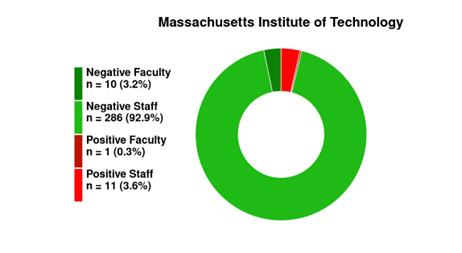

Additionally, MIT’s interactive dashboard showing the sexual and racial composition of the institute was at one time called the “Diversity Dashboard,” but this was changed to the “Demographic Dashboard” sometime around February 2025.57 Similarly, MIT’s Division of Student Life used to have “Social Justice Programing and Cross Cultural Engagement,” but the phrase has since been changed to simply “Intercultural Engagement.”58
If we look a little closer at MIT’s “Intercultural Engagement,” however, we see that it did not do away with “Social Justice Programming” at all. MIT still advertises Intercultural Engagement’s physical space as “a place for ongoing learning… where healthy conversations about diversity, social justice and belonging are not only encouraged, but celebrated.”59 MIT’s Diversity & Inclusion webpage may have likewise rid itself of “Equity” and other such radical concepts, but this is a surface change only. Their events calendar reveals that the office is still promoting radical political concepts such as Queer Theory.60
MIT’s Consortium for Graduate Studies in Gender, Culture, Women, and Sexuality has not slowed down either. In November 2024, the Consortium held an event on pornography and feminism, hosting two porn stars and a founder of a pornographic production company. The description of the event reads:
“Porn is a longstanding site of feminist debate. In contrast to those who see it as a form of violence against women, this panel centers feminist artists and academics who see pornography as a tool for pleasure and politics. Sex educator, artist, and pornographer Annie Sprinkle inspired the Postpornography movement, which is currently thriving among sexual and gender dissidents throughout Latin America and Europe, who make their own porn from a queer or feminist lens. Black Feminist scholars in the United States have re-examined racialized pornography (which was associated with violence and pain), pushing for reading ecstasy, pleasure, and agency into the work of Black women pornographers. Further, scholars and activists have pushed for seeing porn as a form of labor that can be both a site of exploitation and of pleasure. We invite panelists to reflect upon both new pornographies and new ways of interpreting pornography as they intersect with feminist, queer, and anti-racist approaches.”61
Fig. 6 – MIT Flyer for the Pornography and Feminisms Panel Discussion

In another event held in February 2025, the Consortium addressed “Feminism and the Crises of Capitalism,” in which, according to the event description, questions were asked such as: “How do family structures and reproductive labor sustain historical and contemporary forms of racial capitalism? How can feminist and queer lenses illuminate the crises of the current political moment? How have feminist and queer politics engaged and resisted commodification? And what are the possibilities for feminist articulations outside neoliberal vocabularies?”62
Fig. 7 – MIT Flyer for the Feminism and the Crises of Capitalism

MIT’s DEI leadership, which still advocates for these radical philosophies, also remains in place. DEI advocates Melissa Nobles, MIT’s Chancellor, and Kuheli Dutt, the aforementioned Dean of DEI for MIT’s School of Science, still have their jobs, and in Dutt’s case, “Equity” has not been dropped from the title.63
MIT’s pledge to stop requiring Diversity Statements—ideological litmus tests—for teaching faculty is also less than it seems. In January 2025, The College Fix reported that all MIT graduate student applicants to the Sloan School of Management were still being asked to submit an essay that described “a time when you contributed toward making a work environment or organization more welcoming, inclusive, and diverse.”64
Even the greatest piece of evidence that MIT is truly stepping away from DEI came about when, in late May 2025, MIT shuttered its central Diversity office, but this too appears disingenuous.65 MIT’s School of Engineering continues to host a Faculty Gender Equity Committee. The Department of Chemistry still hosts a DEI Committee, as does the Graduate Student Council. The Media Lab still has a DEI working group for the planning of future DEI programs and initiatives. The list goes on.66 One must conclude, therefore, that DEI’s spirit still animates MIT’s actions, no matter the pledges the institution has made.
Much of MIT’s apparent rejection of DEI appears to be an attempt to conceal MIT’s continuing commitment to DEI. On the other hand, many members of the MIT community have undoubtedly awoken to the threat of identity politics. The Hamas massacre of Israeli civilians on October 7, 2023, and the subsequent student protests at MIT’s campus, have had a particularly disillusioning effect. It is unclear, however, just how many members of MIT realize the connection between identity politics, antisemitism, and DEI.67
MIT’s President, Sally Kornbluth, faced calls for resignation after a Congressional hearing in late 2023 over antisemitic incidents at elite schools, despite having failed to answer whether or not calling for the genocide of Jews violated the institution’s policies against bullying and harassment.68 Shortly after the hearing, Melissa Nobles, MIT’s Chancellor, put together a new initiative titled “Stand Together Against Hate,” but it appears to have had little effect.69 Merely days after its inception, a man was recorded urinating on the windows of MIT’s Hillel Center, a Jewish campus organization.70 On March 8, 2024, the U.S. House Committee on Education and the Workforce cited the many anti-Israel and antisemitic social media posts of Afif Aqrabawi, a postdoctoral associate at MIT’s Picower Institute.71
The reputational damage that MIT suffered as a result of these antisemitic incidents and subsequent bad publicity is difficult to measure, but some evidence suggests that prospective students have flocked to southern states. As reported in April 2024, southern colleges have seen a surge of out-of-state students, most of them coming from northeastern states such as Massachusetts, who cite the highly politicized campus climates they faced in their home states as a reason for their decision.72
As for MIT, the institute certainly appears to have taken a hit in its application numbers. Over 33 thousand students applied in 2021 and 2022 to be a part of the Class of 2025 and 2026 respectively, but in 2023 only 26 thousand applied to be a part of the Class of 2027. 2024 saw a slight recovery, but only 28 thousand applied to be a part of the Class of 2028, still roughly five thousand applications short of what the institute received before these antisemitic incidents and violent protests occurred.73 Possibly in an effort to boost the number of applications received, MIT administrators announced in November 2024 that the institute would waive tuition for students with families that had a household income below 200 thousand dollars a year, and those with a household income below 100 thousand dollars could expect a full ride scholarship.74
That same month, and still dealing with the violent protests, MIT banned Prahlad Iyengar, a graduate student, from campus. The administration's decision was made due to Iyengar’s Palestinian activism and especially over his essay “On Pacifism,” which MIT administrators claimed “could be interpreted as a call for more violent or destructive forms of protest at MIT.”75 The irony, of course, is that portions of Iyengar’s essay sound nearly identical to the language often found in the writings of DEI advocates—the same advocates that the MIT administrators placed in senior roles within the institute. To pull one excerpt from Iyengar’s essay:
As people of conscience in the world, we have a duty to Palestine and to all the globally oppressed. We have a mandate to exact a cost from the institutions that have contributed to the growth and proliferation of colonialism, racism, and all oppressive systems. We have a duty to escalate for Palestine, and as I hope I’ve argued, the traditional pacifist strategies aren’t working because they are “designed into” the system we fight against.76
Take a moment to compare the language of Iyengar to that of MIT’s Chancellor, Melissa Nobles, from the Nature article that she was lead-author on back in 2022:
A wave of anti-racism statements followed Floyd’s murder in 2020. Research funders and universities, publishers and individual journals such as Nature all published statements in support of eliminating racism from science. Two years on, the journey from words to action has been slow and, in some respects, barely measurable…
We must have hope that the future will be better than the past, because every alternative is worse. But solutions must also acknowledge the reasons why solutions are necessary. Racism has led to injustices against millions of people, through slavery and colonization, through apartheid and through continuing prejudice today. The point of learning about and analysing racism in science must be to ensure that it is never repeated.77
Two years after making pledges to eliminate racism in science, Nobles took to the pages of Nature to say that the “journey from words to action has been slow and, in some respects, barely noticeable.”78 Two years after that, an MIT graduate student endorses an abandonment of pacifistic protests, taking Nobles’ own power-obsessed philosophy to its logical, violent end.
Fig. 8 – The Poster Adorning the First Page of Iyengar’s Essay, Appearing to Depict a Hamas Fighter Wielding a Kalashnikov Rifle.

In summary, these signs of recovery may well reflect the MIT community’s awakening to the threat posed by DEI’s anti-science, censorial, and authoritarian philosophy, but DEI advocates at the institute continue to promote their philosophy in subtle ways. Even worse, a portion of those advocates have adopted even more radical rhetoric and signaled their willingness to use violence against Jews and anyone else they deem as “oppressors.” MIT’s continuing commitment to DEI ideology, alas, renders it all too plausible that DEI may one day make a truly barbarous resurgence.
Conclusions & Recommendations
While the tide appears to be turning as support for DEI declines, the Massachusetts Institute of Technology is still wrestling with an ideological virus it was infected with a generation ago. It appears as if MIT will continue to struggle with its DEI infestation for years to come. What began in the late 20th century as affirmative action and collegial discussions regarding the policy first transformed into an authoritarian regime, the philosophy of which is antithetical to science, and has now bifurcated into two camps: one celebrating the affectation of perversion under the name of “queer theory”, and one celebrating mass slaughter under the name of “decolonization.”
To fight this ideological disease, we urge MIT community members to join the MIT Free Speech Alliance (MFSA), which is the most effective advocate within MIT for an end to the authoritarian culture of DEI. We also urge MIT administrators to adopt the MFSA’s five Priority Recommendations. These are:
- Recommendation 1. Protect the reputation of the Institute and the diversity of viewpoints by adopting an institutional neutrality policy such as the University of Chicago’s Kalven Report.
- Recommendation 2. Develop an institution or body within MIT that is responsible for addressing concerns around free speech and for organizing the various activities necessary to foster a culture of free speech.
- Recommendation 3. Include required instruction on free speech and expression and MIT’s free speech policies for MIT students at all levels.
- Recommendation 4. Educate administrative staff on the importance of free expression and viewpoint diversity.
- Recommendation 5. Reform the Institute Discrimination and Harassment Response office to ensure proper transparency as well as to limit its actions towards members of the MIT community which serve to inhibit free expression.79
We also recommend that MIT terminate the employment of all DEI staff at once. If they have failed to realize or to reject what their power- and identity-obsessed philosophy has wrought for the institute, especially after the pro-Hamas protests and antisemitic incidents since 2023, then they never will. Either they know and approve of what DEI really intends, or they are incapable of perceiving it accurately. Some may argue that a paradox exists between our recommendations of supporting free speech and terminating DEI staff, but note that we are not calling for the termination of DEI-supportive staff or faculty, nor for the censure of Postmodernists or Critical Theorists. We are only calling for the termination of named DEI staff—such as DEI officers, associate deans for DEI, and other administrators—whose only function is to advocate for DEI and to enforce its underlying ideology. As such, no paradox exists.
The motto of the Massachusetts Institute of Technology is Mens Et Manus, Mind and Hand, which reflects “the educational ideals of MIT’s founders who were promoting, above all, education for practical application.”80 DEI, however, promotes a cynical worldview that corrupts minds and sets hands to a destructive end. MIT cannot live up to its noble motto until it makes a clean break from its commitments to DEI.
1 See “In Posse: “Female” Semen and Other Acts of Resistance,” MIT Museum. https://mitmuseum.mit.edu/on-now/exhibitions/inpossehttps://mitmuseum.mit.edu/on-now/exhibitions/inposse. Due to their extremely graphic nature, we have omitted the screen grabs from the exhibit, but for those still interested, see Mason Goad, Thread on X, 22 April 2024. https://x.com/GoadMason/status/1782423080947610040
2 See MIT ODL Video Services, Committee on Race and Diversity, https://techtv.mit.edu/collections/6754ca8f76114ea081594a602f503b2d/.
3 Faculty Policy Committee, “Statement on Representation of Minorities on the Faculty and in the Graduate Student Body,” MIT Faculty Governance, May 4, 2004, https://facultygovernance.mit.edu/sites/default/files/reports/2004-05_FPC_Statement_Representation_of_Minorities.pdf.
4 See “Demography Dashboard,” MIT, Institutional Research, https://ir.mit.edu/diversity-dashboard/.
5 Greg Frost, “Celebrating MLK: Much has been done, much work remains, speakers say,” MIT Tech Talk, vol. 52, no. 7, February 27, 2008, 1-8, https://news.mit.edu/newsoffice/2008/techtalk52-17.pdf.
6 “MIT Diversity Leadership Congress,” Internet Archive Wayback Machine, November 18, 2008, https://web.archive.org/web/20090420060012/http:/web.mit.edu/diversityleaders/.
7 L. Rafael Reif, “Summary Statement,” MIT, http://web.mit.edu/provost/raceinitiative/exec-summ.html; Report on the Initiative for Faculty Race and Diversity, MIT, 2010, http://web.mit.edu/provost/raceinitiative/report.pdf.
8 See “Diversity & Inclusion at MIT,” Internet Archive Wayback Machine, https://web.archive.org/web/20090420060002/http:/web.mit.edu/diversity/index.html; See “MIT Office of Minority Education,” Internet Archive Wayback Machine, https://web.archive.org/web/20120711110759/https:/ome.mit.edu/; See “MIT Institute Community & Equity Office,” Internet Archive Wayback Machine, https://web.archive.org/web/20150519225744/https:/iceo.mit.edu/.
9 “Black Graduate Student Association recommendations,” MIT Institute Commitments, December 1, 2015, https://commitments.mit.edu/black-graduate-student-association-recommendations.
10 Melissa Nobles et al., “Ongoing investment in a better MIT,” Organization Chart, February 4, 2020, https://orgchart.mit.edu/node/5/letters_to_community/ongoing-investment-better-mit.
11 “EXCLUSIVE: A new start turns to a tragic end for George Floyd, who moved to Minneapolis determined to turn his life around after being released from prison in Texas,” Daily Mail UK, May 28, 2020, https://www.dailymail.co.uk/news/article-8366533/George-Floyd-moved-Minneapolis-start-new-life-released-prison-Texas.html.
12 Associated Press, “MIT Chaplain Resigns After Email Doubting Floyd-Racism Link,” Voice of America, June 17, 2020, https://www.voanews.com/a/usa_race-america_mit-chaplain-resigns-after-email-doubting-floyd-racism-link/6191274.html.
13 L. Rafael Reif, “Letter regarding efforts to address systemic racism at MIT,” MIT News, July 1, 2020, https://news.mit.edu/2020/letter-systemic-racism-mit-0701.
14 Mason Goad, “KGB Documents Show the Secret History of Ibram X. Kendi’s “Antiracist” Movement,” Minding the Campus, August 29, 2022, https://www.mindingthecampus.org/2022/08/29/kgb-documents-show-the-secret-history-of-ibram-x-kendis-antiracist-movement/.
15 Elizabeth Thomson, “Activist and scholar Angela Davis addresses racism in MIT webcast,” MIT News, October 20, 2020, https://news.mit.edu/2020/activist-scholar-angela-davis-addresses-racism-mit-webcast-1030.
16 Institute Community and Equity Office, “MIT welcomes six new assistant deans for diversity, equity, and inclusion,” MIT News, June 28, 2021, https://news.mit.edu/2021/assistant-deans-diversity-equity-inclusion-0628.
17 Dorian S. Abbot and Ivan Marinovic, “The Diversity Problem on Campus,” Newsweek, 12 August, 2021. https://www.newsweek.com/diversity-problem-campus-opinion-1618419
18 Martin A. Schmidt, “Important update re. EAPS,” Organization Chart, October 7, 2021, https://orgchart.mit.edu/node/6/letters_to_community/important-update-re-eaps.
19 L. Rafael Rief, “Reflections and a path forward on community and free expression,” MIT Office of the President, October 18, 2021, https://president.mit.edu/speeches-writing/reflections-and-path-forward-community-and-free-expression.
20 “Details on MIT faculty forum polls on freedom of expression,” MIT Free Speech Alliance, https://www.mitfreespeech.org/facultypoll.
21 Tom Hafer and Henry I. Miller, “Goodbye, MIT,” City Journal, November 5, 2021, https://www.city-journal.org/mit-caves-to-wokeness.
22 See “About,” The Babbling Beaver, https://babblingbeaver.com/about/; See “About,” MIT Free Speech Alliance, https://www.mitfreespeech.org/about; MIt Free Speech Alliance, “MIT Free Speech Alliance Receives $500,000 Stanton Foundation Grant,” Cision, May 23, 2022, https://www.prnewswire.com/news-releases/mit-free-speech-alliance-receives-500-000-stanton-foundation-grant-301552863.html.
23 Stu Schmill, “We are reinstating our SAT / ACT requirement for future admissions cycles,” MIT Admissions, March 28, 2022, https://mitadmissions.org/blogs/entry/we-are-reinstating-our-sat-act-requirement-for-future-admissions-cycles/; John Rosales and Tim Walker, “The Racist Beginnings of Standardized Testing,” National Education Association, March 20, 2021, https://www.nea.org/advocating-for-change/new-from-nea/racist-beginnings-standardized-testing.
24 See Report of the MIT Ad Hoc Working Group on Free Expression, Faculty Governance MIT, June 24, 2022, https://facultygovernance.mit.edu/sites/default/files/reports/2022-09_Final_Report_of_the_Ad_Hoc_Working_Group_on_Free_Expression.pdf.
25 Peter Dizikes, “MIT releases strategic action plan for belonging, achievement, and composition,” MIT News Office, September 1, 2022. https://news.mit.edu/2022/plan-belonging-achievement-composition-0901; see “MIT Strategic Action Plan for Belonging, Achievement, and Composition,” MIT, September 1, 2022, https://actionplan.mit.edu/sites/default/files/MIT-Strategic-Action-Plan.pdf
26 “MIT’s Institutional Health,” The Foundation for Individual Rights in Education, 2023, https://www.thefire.org/sites/default/files/2023/01/MIT%20Institutional%20Health%20Report%20FULL%203.pdf; Daryl Morey, “The Numbers Show that MIT Has a Free-Speech Problem,” Wall Street Journal, January 23, 2023, https://www.wsj.com/articles/the-numbers-show-that-mit-has-a-free-speech-problem-controversial-education-students-college-self-censor-11674514243.
27 See MIT Linguistics, “Noam Chomsky,” https://linguistics.mit.edu/user/chomsky/; MIT IHTFP, “Hack Gallery,” https://hacks.mit.edu/
28 See Helen Pluckrose and James Lindsay, Cynical Theories: How Activist Scholarship Made Everything about Race, Gender, and Identity – and Why This Harms Everybody (Durham, NC: Pitchstone Publishing, 2020), pg. 59-60. https://www.amazon.com/Cynical-Theories-Scholarship-Everything-Identity_and/dp/1634312023
29 Pluckrose and Lindsay, Cynical Theories, pg. 45-66.
30“Feminist, Queer, and Indigenous Methods,” Consortium for Graduate Studies in Gender, Culture, Women, and Sexuality, https://www.gcws.mit.edu/new-events/feminist-queer-indigenous-methods.
31 BDSM stands for Bondage, Domination / Discipline, Sadism, and Masochism.
32 “Feminisms Unbound – Erotic Methods,” Consortium for Graduate Studies in Gender, Culture, Women, and Sexuality, https://www.gcws.mit.edu/gcws-events-list/feminisms-unbound-erotic-methods?utm_campaign=meetedgar&utm_medium=social&utm_source=meetedgar.com.
33 “A Queerness of Biblical Proportions: Queer Theory and Biblical Interpretation,” Consortium for Graduate Studies in Gender, Culture, Women, and Sexuality, https://www.gcws.mit.edu/new-events/queerness-biblical-proportions
34 See “In Posse: “Female” Semen and Other Acts of Resistance,” MIT Museum. https://mitmuseum.mit.edu/on-now/exhibitions/inpossehttps://mitmuseum.mit.edu/on-now/exhibitions/inposse. Again, we have omitted the screen grabs from the exhibit due to their explicit nature, but for those still interested,, see Mason Goad, Thread on X, 22 April 2024. https://x.com/GoadMason/status/1782423080947610040
35 Pluckrose and Lindsay, Cynical Theories, pg. 59-60, 198-207.
36 See Pluckrose and Lindsay, Cynical Theories.
37 Ibram X. Kendi, “How to Fix Inequality: Pass an Anti-Racist Constitutional Ammendment,” Politico, 2019. https://www.politico.com/interactives/2019/how-to-fix-politics-in-america/inequality/pass-an-anti-racist-constitutional-amendment/
38 See Report of the MIT Ad Hoc Working Group on Free Expression, Faculty Governance MIT, June 24, 2022, https://facultygovernance.mit.edu/sites/default/files/reports/2022-09_Final_Report_of_the_Ad_Hoc_Working_Group_on_Free_Expression.pdf.
39 Kuheli Dutt, “Race and Racism in the Geosciences,” Nature Geoscience, vol. 13, no. 2-3 (2020), https://www.nature.com/articles/s41561-019-0519-z.
40 School of Science, “3 Questions: Kuheli Dutt reflects on diversity in science,” MIT News, February 8, 2022, https://news.mit.edu/2022/3-questions-kuheli-dutt-reflects-diversity-science-0108.
41 Melissa Nobles, Chad Womack, Ambroise Wondam, and Elizabeth Wathuti, “Science must overcome its racist legacy,” Nature, June 8, 2022, https://www.nature.com/articles/d41586-022-01527-z.
42 MIT Division of Student Life, “MIT’s Diversity Orientation Program,” https://web.archive.org/web/20221007140726/https://studentlife.mit.edu/impact-opportunities/diversity-inclusion/spxce/diversity-orientation
43 “First-Year Residency Requirement,” MIT Division of Student Life, https://studentlife.mit.edu/housing/housing-policies/first-year-residency-requirement#:~:text=Housing%20%26%20Residential&text=We%20require%20a%20letter%20of,he%2Fshe%20would%20be%20living: See also “Social Justice Programming & Cross Cultural Engagement,” MIT Division of Student Life, https://web.archive.org/web/20221006013423/https://studentlife.mit.edu/spxce
44 MIT School of Humanities, Arts, and Social Sciences, “Undergraduate Study,” https://shass.mit.edu/for-students/undergraduate-study/#:~:text=All%20undergraduates%20must%20complete%20the,breadth%2C%20depth%2C%20or%20choice.
45 MIT School of Humanities, Arts, and Social Sciences, “MIT SHASS courses on diversity-related issues,” https://web.archive.org/web/20220419021042/https://shass.mit.edu/undergraduate/courses-on-diversity-related-issues
46 “The Black Radical Tradition in America,” MIT Registrar’s Office, http://student.mit.edu/catalog/search.cgi?search=21H.229&style=verbatim&when=*&termleng=4&days_offered=*&start_time=*&duration=*&total_units=*.
47 “Gender, Race, and Environmental Justice,” MIT Registrar’s Office, http://student.mit.edu/catalog/search.cgi?search=21A.407J&style=verbatim&when=*&termleng=4&days_offered=*&start_time=*&duration=*&total_units=*.
48 “New Culture of Gender: Queer France,” MIT Registrar’s Office, http://student.mit.edu/catalog/search.cgi?search=21G.325J&style=verbatim&when=*&termleng=4&days_offered=*&start_time=*&duration=*&total_units=*.
49 “Identities and Intersections: Queer Literatures:,” MIT Registrar’s Office, http://student.mit.edu/catalog/search.cgi?search=WGS.245J&style=verbatim&when=*&termleng=4&days_offered=*&start_time=*&duration=*&total_units=*.
50 “Language and Power,” MIT Registrar’s Office, http://student.mit.edu/catalog/search.cgi?search=24.252&style=verbatim&when=*&termleng=4&days_offered=*&start_time=*&duration=*&total_units=*.
51 “Science Activism: Gender, Race, and Power,” MIT Registrar’s Office, http://student.mit.edu/catalog/search.cgi?search=WGS.160J&style=verbatim&when=*&termleng=4&days_offered=*&start_time=*&duration=*&total_units=*.
52 “Intersectional Feminist Memoir:,” MIT Registrar’s Office, http://student.mit.edu/catalog/search.cgi?search=WGS.238J&style=verbatim&when=*&termleng=4&days_offered=*&start_time=*&duration=*&total_units=*.
53 “Racial Justice and anti-racism resources,” MIT Libraries, https://libguides.mit.edu/racial-justice.
54 “About MIT / Mission Statement,” MIT, https://www.mit.edu/about/mission-statement/
55 Ryan Quinn, “MIT Will Stop Asking Faculty Applicants for Diversity Statements,” Inside Higher Ed, 8 May 2024. https://www.insidehighered.com/news/quick-takes/2024/05/08/mit-stops-asking-faculty-applicants-diversity-statements#
56 Mason Goad and Louis Galarowicz, “Ideological Insistence: A Quantitative Study of DEI Statements in American University Job Listings,” The National Association of Scholars, DATE, URL
57 See MIT Institutional Research, “Demographic Dashboard,” https://web.archive.org/web/20250214144957/https://ir.mit.edu/projects/diversity-dashboard/ and WayBack Machine’s final crawl of the “Diversity Dashboard” from February 14th 2025: https://web.archive.org/web/20250214144957/https://ir.mit.edu/projects/diversity-dashboard/
58 See Wayback Machine for MIT’s “Social Justice and Cross Cultural Engagement” https://web.archive.org/web/20221006013423/https://studentlife.mit.edu/spxce and MIT’s new “Intercultural Engagement.” https://studentlife.mit.edu/ixe
59 See MIT’s Division of Student Life, “About Cultural Engagement,” https://studentlife.mit.edu/ixe/about-intercultural-engagement#:~:text=Intercultural%20Engagement%20(i.e.)%20provides%20support,cultural%2Fidentity%20based%20student%20organizations.
60 See MIT Division of Student Life, “LGBTQ+” https://studentlife.mit.edu/lbgtqmit
61 MIT Consortium for Graduate Studies in Gender, Culture, Women, and Sexuality: “Feminisms Unbound — Pronography and Feminisms,” https://www.gcws.mit.edu/gcws-events-list/pornography-and-feminisms
62 MIT Consortium for Graduate Studies in Gender, Culture, Women, and Sexuality: “Feminisms Unbound — Feminism and the Crises of Capitalism,” https://www.gcws.mit.edu/gcws-events-list/feminism-and-the-crises-of-capitalism
63 See MIT Organization Chart, https://orgchart.mit.edu/leadership/chancellor/letters#tabletters; see also MIT School of Science, “Contact,” Accessed 3 March 2025. https://science.mit.edu/contact/
64 Maria Davis, “MIT still requires DEI essay of grad students after abandoning faculty pledge,” The College Fix. January 21, 2025. https://www.thecollegefix.com/mit-still-requires-dei-essay-of-grad-students-after-abandoning-faculty-pledge/
65 Chris Lau, Ruben Correa, and Matt Rehbein, “MIT is shuttering DEI office amid Trump administration’s push to end diversity programs,” CNN, 29 May 2025. https://www.cnn.com/2025/05/29/us/mit-shuttering-dei-office-hnk
66 Nathaniel Urban, “MIT Canceled DEI - Just Kidding,” Minding the Campus, June 11, 2025. https://www.mindingthecampus.org/2025/06/11/mit-canceled-dei-just-kidding/
67 Mason Goad, “KGB Documents Show the Secret Link Between “Anti-Racists” and Palestinian Terrorists,” Minding the Campus, October 26, 2023. https://www.mindingthecampus.org/2023/10/26/kgb-documents-show-the-secret-link-between-anti-racists-and-palestinian-terrorists/
68 Amaris Enclnas, “MIT President outlines 'new steps' for 2024: What to know about Sally Kornbluth,” USA Today, January 3, 2024. https://www.usatoday.com/story/news/nation/2024/01/03/sally-kornbluth-mit-president/72099065007/
69 MIT News Office, “3 Questions: Melissa Nobles on combating antisemitism and Islamophobia,” December 4, 2023. https://news.mit.edu/2023/3q-melissa-nobles-combating-antisemitism-and-islamophobia-1204
70 Talia Khan, Post on X, December 6, 2023. https://x.com/realtaliakhan/status/1732505063648563395
71 Canary Mission, “Afif Aqrabawi: Overview,” https://canarymission.org/professor/Afif_Aqrabawi
72 Eric Spitznagel, “Kids Are Giving Up on Elite Colleges—and Heading South,” The Free Press, April 22, 2024. https://www.thefp.com/p/kids-skip-ivy-league-for-southern-schools
73 See MIT Admissions, “Admissions Statistics,” https://mitadmissions.org/apply/process/stats/; see also the Internet Archive’s crawls of the same page for the years for the Class of 2027 https://web.archive.org/web/20240306101602/https://mitadmissions.org/apply/process/stats/, the Class of 2026 https://web.archive.org/web/20230315015239/https://mitadmissions.org/apply/process/stats/, and the Class of 2025 https://web.archive.org/web/20230315015239/https://mitadmissions.org/apply/process/stats/.
74 Leah Sarnoff, “Massachusetts Institute of Technology to waive tuition for families making less than $200K,” ABC News, November 20, 2024. https://abcnews.go.com/US/massachusetts-institute-technology-waive-tuition-families-making-200k/story?id=116054921
75 Middle East Students’ Association, “Letter to MIT expressing concern about its disciplinary action against Prahlad Iyengar,” https://mesana.org/advocacy/committee-on-academic-freedom/2024/11/16/letter-to-mit-expressing-concern-about-its-disciplinary-action-against-prahlad-iyengar
76 Prahlad Iyengar, “On Pacifism,” Written Revolution, No. 5. https://babblingbeaver.com/wp-content/uploads/2024/11/On-Pacifism-by-Prahlad-Iyengar.pdf
77 Melissa Nobles, Chad Womack, Ambroise Wonkam & Elizabeth Wathuti, “Science must overcome its racist legacy: Nature’s guest editors speak,” Nature, June 8, 2022. https://www.nature.com/articles/d41586-022-01527-z
78 Ibid.
79 MIT Free Speech Alliance, “MFSA Recommendations for Restoring Free Speech at MIT,” https://www.mitfreespeech.org/mfsa_recommendations.php
80 MIT Admissions, “What is MIT’s Motto?” https://mitadmissions.org/help/faq/motto-mens-et-manus/

