


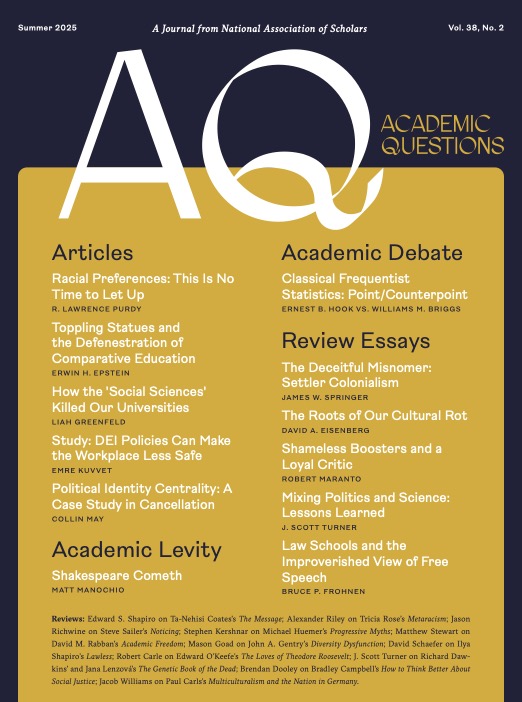
Noticing: An Essential Reader (1973-2023), Steve Sailer, Passage Publishing, 2024, pp. 458, $29.95 softcover.
“I read Steve Sailer.” For many years in Washington, this statement seemed impossible to make in public without first looking around warily, dropping to a whisper, and swearing one’s comrades to secrecy. The covert admission would usually be met with knowing nods. “We all read him,” the nods implied. “But you’re not supposed to say it!”
Now the taboo may finally be lifting. With the publication of Noticing, a collection of his best essays, Sailer has enjoyed a nationwide speaking tour. Suddenly it is not so scandalous to hear his name dropped in mixed company. References to his favorite themes, such as the “Zeroth Amendment” or “Sailer’s Law of Female Journalism,” have become more common. While Sailer’s appeal is still mostly on the political right, the reporter-turned-independent blogger is more influential than ever before.
What has made Sailer’s writing simultaneously popular and taboo? The answer is the title of his book. He does a lot of noticing. Or, to be more precise, he’s willing to notice. He gives voice to observations that others consider impolite, or even offensive, but are nonetheless valuable.
Some of that value comes from transgressive humor. For example, Sailer’s Law of Female Journalism states that, “The most heartfelt articles by female journalists tend to be demands that social values be overturned in order that, Come the Revolution, the journalist herself will be considered hotter-looking.” Noticing the myriad examples of this “law” can be entertaining, but it also carries a substantive lesson. Although formal barriers to female advancement have diminished, and women now hold a number of traditionally male jobs, their interests and behaviors still diverge from men’s. Indeed, sex differences are actually greater in places with legal equality and high levels of individualism, such as Scandinavia.1 The foundational claim of radical feminism, that the reproductive role is the only meaningful difference between the sexes, has been falsified many times over.
Sailer’s “laws” need not be humorous to be instructive. When mass shootings are breaking news, it can be frustrating when the authorities are not forthcoming with details. Helpfully, Sailer has noticed that the race of the shooter can usually be inferred from the casualty counts. Specifically, more wounded than killed implies a black shooter, and the reverse implies the shooter is white (or at least not black). This is not just some grim trivia. It actually illustrates the dual nature of gun violence in the U.S. The occasional extremist (typically white) can achieve a horrifyingly high kill rate with an AR-15. However, mass shootings more often involve a petty dispute that escalates into someone (usually black) firing a handgun haphazardly into a crowd, resulting in many injuries but lower lethality. Unfortunately, the infamous AR-15 incidents have obscured the overwhelming role that handguns play in firearms violence.
Perhaps nothing illustrates the importance of noticing more than the “transgender” movement. Even before Bruce Jenner began calling himself Caitlyn in 2015, Sailer had been explaining to his readers how transgender ideology does not comport with reality. Why, he asked rhetorically, do so many men who claim to be women “on the inside” seem to be so stereotypically masculine? If Bruce Jenner has always been “a woman trapped in a man’s body,” his life as a world-class athlete, thrice-married father of six, and aviation enthusiast seems rather unlikely.
Similarly, the Jeopardy champion Amy Schneider, a man who now claims to be a woman, once told an interviewer that his favorite film is Master and Commander, a story of Napoleonic-era naval warfare in which women play virtually no role. “Films don’t get much more girlish than Master and Commander,” Sailer snarked. “What little girl hasn’t wanted to grow up to be a master and commander?”
After American Enterprise Institute war hawk Thomas Donnelly declared himself a woman named Giselle, Sailer was again sarcastic: “Giselle was always a true woman on the inside, a genuine woman who is obsessed, like all normal girls, with thinking about war, military hardware, neoconservatism, wonkery, and playing electric guitar rock.”
Larry and Andy Wachowski are filmmaker brothers famous for The Matrix, an immensely creative sci-fi action film that spawned several sequels. The Wachowski brothers later became the Wachowski sisters, Lana and Lilly. “Did anyone anywhere ever notice anything girly about the six hours of The Matrix trilogy?” Sailer asked. “Instead, it was the universal opinion of mankind that it represented the apotheosis of the male nerd imagination.”
Why do so many men who are “women on the inside” fail to act the least bit feminine on the outside? Summarizing the pioneering work of psychologist Ray Blanchard, Sailer explains that there are two distinct types of men who want to be women. The first type are extremely effeminate homosexuals whose condition is obvious long before puberty. (Think Dylan Mulvaney of Bud Light advertising infamy.) The second and more numerous type are what Blanchard calls “autogynephiles.” They are non-homosexual men who eroticize seeing themselves as women. Autogynephiles are attracted to women, but they experience a “targeting error” that causes that attraction to reflect back on themselves. They wish to become the objects of their own desire. They are, as another expert put it, “men trapped in men’s bodies.”2
Needless to say, the fact that most men who dress as women do so because of a sex fetish is not the story that transgender activists wish to tell. They insist on the “woman on the inside” narrative—unbelievable as it may be for men such as Jenner, Donnelly, et al.—because it evokes more sympathy for their condition.
This lie is not noble, however. Young people struggling with the challenges of adolescence have latched on to it, with disastrous results. Problems that would once be diagnosed as simply depression or anxiety related to their physical maturation are now thought to be due to being a “boy in a girl’s body” or a “girl in a boy’s body.” That false paradigm has made teenage transgenderism a destructive fad, similar to the outbreak of anorexia in the 1990s. Now instead of starving themselves, adolescents are obtaining cross-sex hormones and sterilizing surgeries. Sailer argues that if activists told the truth about transgenderism, the number of young people who suddenly insist they are in the wrong body would surely lessen.
On the fraught issue of immigration, Sailer has also been ahead of the game. To appreciate his prescience here, one must understand how radically the Biden administration altered immigration policy. First, Biden promised to remove key deterrents, such as the Trump rule that asylum seekers must remain in Mexico while their cases are adjudicated. Then, instead of cracking down on the resulting border surge, he facilitated it. He had the Border Patrol simply wave through inadmissible migrants, giving them a court date that could be years in the future. He used the parole power to write his own “legal” immigration policy, welcoming whomever he wanted regardless of whether they had valid visas. Biden continued these policies for years, even as border states and big-city immigrant destinations were inundated and begging for relief.
The results are staggering. The foreign-born population increased during Biden’s term from 45 million to 53.3 million. The foreign-born share increased to 15.8 percent—an all-time record that the Census Bureau had recently predicted the U.S. would not reach until 2042. In fact, the bureau had so much trouble keeping up with the influx that it had to revise net international migration in 2022 and 2023 to double the original estimate.3
Why did the Biden administration allow immigration to dramatically exceed the statutory limits set by Congress? The administration itself offered a long list of excuses—the surge is part of a seasonal pattern, it’s a resumption of prior trends interrupted by Covid, it’s caused by “push factors” beyond the administration’s control, it’s due to the failure of amnesty legislation, and so on. These excuses were always difficult to take seriously, and they were fully discredited once border encounters fell to record lows under the second Trump administration.
Since the official excuses were empty, darker theories filled the void. The Biden administration was deliberately flooding the nation with future Democratic voters, according to some critics, or it was perhaps even attempting to destroy civil society to make room for more government. While some administration officials may have had those motivations, what really seemed to be driving the Biden policy was an emerging anti-borders ideology among progressives. Put simply, many progressive activists no longer believe that nations have the right to limit immigration.
Sailer summarizes that view with a tongue-in-cheek reference to the “Zeroth Amendment”—an imaginary addition to the Bill of Rights that guides progressive thinking. The humorous version of the Zeroth Amendment reads, “The President shall enforce no law respecting an establishment of borders, or prohibiting the free crossing thereof.” In more serious terms, the Zeroth Amendment establishes a presumption that foreigners have the right to move here. Sailer places it before the rest of the Bill of Rights because it seems to take precedence in progressives’ minds over other (actual) enumerated rights, especially the First Amendment right to speak out against immigration.4
When candidate Trump in 2016 stated that “no one has a right to immigration to this country,” his opponent Hillary Clinton said she disagreed. As Sailer noted even back then, the Zeroth Amendment framework helps explain why. It also explains why Clinton announced that she would deport only violent criminals and terrorists. Fast-forward to early in Trump’s second term, when a Wisconsin judge allegedly evacuated an illegal immigrant through a backdoor of her courtroom to help the immigrant sidestep ICE agents. Why would a judge risk her own arrest for felony obstruction just to protect an illegal immigrant who was in court on charges of domestic violence? The Zeroth Amendment.
As we have seen, Sailer’s appeal as a writer is that he generates so many insights that are hard to find anywhere else. His longtime problem, as we have also seen, is that those insights come from his willingness to notice patterns that sometimes qualify as stereotypes. Stereotyping seems so impolite that few other writers are willing to go where he does. And yet, as the social psychologist Lee Jussim has shown, most stereotypes are accurate.5 There is no reason democracies cannot treat people as individuals while still acknowledging—and learning from—the broader patterns of human behavior. Therefore, it’s time to say it out loud: I read Steve Sailer, and you should too.
Jason Richwine is a resident scholar at the Center for Immigration Studies. He last appeared in AQ in spring 2023 with “The Victimhood Cult,” a review of Vivek Ramaswamy’s A Nation of Victims: Identity Politics, The Death of Merit, and the Path Back to Excellence (2022).
1 David P. Schmitt, et al., “Why Can't a Man Be More Like a Woman? Sex Differences in Big Five Personality Traits Across 55 Cultures,” Journal of Personality and Social Psychology, 2008.
2 Anne A. Lawrence, Men Trapped in Men's Bodies: Narratives of Autogynephilic Transsexualism, New York: Springer, 2013.
3 Jason Richwine, “New Data Reveal the Scale of Biden’s Immigration Surge,” National Review, March 13, 2025.
4 Steve Sailer, “Slate: Trim First Amendment to Save Zeroth Amendment,” Unz Review, December 16, 2025.
5 Lee Jussim, et al., “Stereotype (In)Accuracy in Perceptions of Groups and Individuals,” Current Directions in Psychological Science, 2025.