


Executive Summary
In addition to the Massachusetts Institute of Technology (MIT) and the Georgia Institute of Technology (Georgia Tech), the California Institute of Technology (Caltech) is one of a handful of universities essential to ensuring America’s position as a technological and scientific powerhouse. While “diversity, equity, and inclusion” (DEI) is well-known as a pervasive ideology rooted in Critical Theory within the humanities and social sciences, the extent to which DEI has infiltrated the hard sciences and administrative bureaucracies within these fields is less well-documented.
This report documents the growth and operation of DEI at Caltech, as well as its rebranding over the past two years. First, the development of DEI within Caltech’s administration is documented, along with the various ways the university’s DEI bureaucracy attempts to navigate and cater to various identity groups while shaping campus culture. This report also highlights the awkwardness and ideologically performative nature of DEI in relation to Caltech’s international student body and in addressing real campus tensions surrounding anti-Semitism
Methodology
This report relied upon an extensive survey of publicly available information from Caltech’s official websites, statements from the university president, and outside articles and media reports. Much of Caltech’s DEI material is only available behind private login pages. To gather additional information, interviews were conducted where possible, given that Caltech is a private institution. Multiple attempts were made to secure interviews with personnel and leaders from Caltech Center for Inclusion and Diversity (CCID); however, no calls were returned.
Chapter 1: History and Institutionalized DEI At Caltech
The California Institute of Technology, more commonly known as “Caltech,” is an institution integral to American national security and maintaining the nation’s technological superiority. In 2022, a study conducted by Quartz on the most influential colleges in STEM fields (Science, Technology, Engineering, and Math) ranked Caltech as the most influential college in the United States devoted to the sciences.1 During World War II, Caltech played an instrumental role in the Manhattan Project, and included Robert Oppenheimer among its professors.2 Despite the university’s storied status in American science, Caltech has not proven immune to the “diversity, equity, and inclusion” (DEI) trends that have swept through the broader realm of academia, threatening to undermine excellence and civil rights in Caltech’s scientific and technical programs.
The National Association of Scholars (NAS) noted in 2009 that Caltech remained a standout example of an institution devoted to excellence amid a growing general obsession with racial quotas among colleges and universities.3 That same year, Caltech began institutionalizing DEI by merging the Minority Student Education office and the Women’s Center into the Caltech Center for Inclusion and Diversity (CCID).4 Along with “inclusion, diversity, equity, and accessibility (IDEA)” programming, Caltech has continued integrating DEI across its institutional landscape.5
Much of Caltech’s adoption of DEI began or grew during the tenure of its president, Thomas F. Rosenbaum. Rosenbaum was first hired as Caltech’s president in 2013, when he was serving as the John T. Wilson Distinguished Service Professor of Physics at the University of Chicago and as the university’s provost.6 While in Chicago, Rosenbaum oversaw the creation of a charter school program tied to the university that aimed to increase college placement among “disadvantaged Chicago youths.”7 Rosenbaum mentioned both “diversity” and “identity” in his inaugural address, describing how identity played a role in his family’s history fleeing Nazi Germany.8 For diversity, Rosenbaum invoked Caltech founder Robert Millikan, a winner of the 1923 Nobel Prize in Physics, and Caltech’s first president, as integral to shaping how Caltech approaches the advancement of knowledge, stating:
Millikan's synthetic view of scholarship was unusual for its time and remains so almost 100 years later. The effective combination of the pure and the applied to advance knowledge and benefit society requires a number of elements, many of which characterize the Caltech of today: An absolute commitment to excellence. Every appointment—student, faculty and staff—matters. Intrinsic to this strategy is the need for diversity: diversity of thought, diversity of background, diversity of experience. We must cast the net as broadly as possible to recruit and retain the most inventive and original scholars.9
Rosenbaum was interviewed for the Summer 2014 issue of E&S Magazine, where he was asked explicitly about what he learned about the “process of expanding diversity that may be applicable at Caltech.”10 Rosenbaum stated that
Diversity is integral to the values and success of Caltech; it is not an add-on. Universities are in the essential business of attracting the most original, creative, and compelling scholars and creating an environment of unflinching inquiry and challenge. These aspects of academic eminence require faculty, students, and staff from a wide range of backgrounds and with diverse perspectives.11
Rosenbaum’s awkward attempt to combine a commitment to both diversity and academic excellence would come to define DEI’s operations at Caltech over the next decade.
Rosenbaum’s invocation of Millikan is ironic, given that in the aftermath of the death of George Floyd in 2020, Caltech would begin a campaign to rename campus buildings and programs carrying Millikan’s name, as well as the names of several other important figures in Caltech’s history.12 Rosenbaum himself was an enthusiastic proponent of the erasure.13 Rosenbaum created an “advisory committee” to examine Caltech’s recruitment efforts in a move to increase campus diversity.14
Caltech’s DEI agenda is driven from the top down, but has evolved over time into an increasingly explicit commitment to placing it at ever-deeper levels of administration. For example, Caltech’s official webpage devoted to IDEA programming carries a statement from the Board of Trustees that notably avoids explicit language about identity, instead couching the commitment to diversity in terms of excellence and diverse viewpoints. The statement from the Board of Trustees states that:
With its overriding and unwavering commitment to excellence, Caltech strives to be the destination of choice for students, faculty, and staff with the brightest and most creative minds from all backgrounds and viewpoints who are committed to fulfilling the Institute’s core mission of expanding human knowledge and benefitting society.15
Language about “equity” and “inclusion” is more explicit in the statement from Caltech president Rosenbaum, stating that:
A diverse and inclusive campus creates an environment where our lives are enriched by the different experiences and perspectives of colleagues, our preconceptions are challenged, our research is broadened, and our ideas are refined through the expansive exchange of ideas. Realizing this environment is essential for Caltech to remain a destination of choice for the most outstanding scholars. It is only when individuals from all backgrounds share equitably in the privileges of the academy that we will realize fully the potential of science and engineering to create knowledge for the ages and improve people's lives today.16
In 2022, Rosenbaum’s committee recommended “renaming campus buildings, conducting a campus climate survey, and increasing support for students of color and other underrepresented groups.”17 Caltech began implementing DEI through the academic parts of the university’s institutional structure.
Chemistry professor Brian Stoltz, who oversaw DEI efforts at the Division of Chemistry and Chemical Engineering (CCE), stated that the “campus became galvanized around the George Floyd murder…a lot of people looked around the world and said it’s hard to change the world, but we control our destiny on campus, so let’s try to make this the most inclusive place we can.”18 Stoltz stated that the CCE sought a “bottom-up approach to DEI initiatives, inviting research groups—and the students in them—to bring forth proposals for making the division a more inclusive place.”19 This approach culminated in the implementation of “DEI coordinators modeled after safety officers in the division,” so that “each group would have a DEI coordinator that would promote DEI values within the research group...this is a nice way for us to have student boots on the ground.”20 Stoltz outlined how DEI would work structurally in the division, namely by placing a “nine-member diversity committee whose members include students, postdocs, and faculty members” between the various research groups and the division’s own administration.21
CCE’s own initiatives included the creation of a fund for student travel, the adoption of the “Future Ignited” program to connect “students of color considering a graduate degree in chemistry,” the implementation of the Donald Alstadt Workshop for Caltech students and faculty members to speak to “underrepresented and low-income students” about STEM careers, and “WAVE Fellowships” to offer nine more students from Historically Black Colleges and Universities (HBCUs) the funds to support study at Caltech.22 In this way, DEI was established to operate at every level of campus work, with CCE serving as a model.
At the physical level of the campus itself, Caltech began renaming buildings in late 2020 to help encourage DEI. Caltech’s Committee on Naming and Recognition unanimously decided to rename the Robert A. Millikan Memorial Library and “other assets and honors” that memorialized Millikan and several other distinguished scientists and affiliates of Caltech, who had been deemed guilty of a variety of post-George Floyd sins. To quote from the report of the Committee’s report: 23
On May 25, 2020, police officers in Minneapolis, Minnesota, killed George Floyd, a 46-year-old Black man. The tragedy triggered international outrage and protests. In the weeks that followed, Institute leadership received calls for action to improve diversity and inclusion within the Caltech community. Two significant petitions, each with more than 1,000 signatures, demanded the removal from all campus assets and honors of the names of past Institute leaders who had been associated with eugenics and the HBF [note: the Human Betterment Foundation, a eugenics advocacy group.]. One petition, dated June 25, 2020, was submitted by the Black Scientists and Engineers of Caltech. The second petition, dated July 22, 2020, was authored by Michael Chwe, a Caltech alumnus who is now a professor of political science at UCLA.
On July 22, 2020, in response to these two petitions and a number of campus conversations, President Rosenbaum established the Committee on Naming and Recognition (CNR). Members of the CNR were selected as representatives of, and representatives for, the Institute community, with pertinent expertise across history, biology, genetics, biological ethics, psychology, physics, law, alumni relations, diversity and inclusion, and corporate governance. The CNR was asked to explore how the Institute honors and memorializes significant historical figures. Of specific concern were memorializations of Millikan, [Harry] Chandler, [Ezra S.] Gosney, [William B.] Munro, [Henry m.] Robinson, and [Albert B.] Ruddock, all because of their connections to the HBF. The memorialization of Thomas J. Watson Sr., was also of concern because of his role at IBM, and IBM's ties to Nazi Germany. The committee's mandate involved a delineation of principles for current and future naming, and recommendations for specific actions, with special consideration of Caltech's ability to be a destination of choice, today and into the future, for a diverse community of exceptional scholars.24
Caltech’s renaming committee determined that Millikan and the others whose names would be purged were problematic due to their involvement in the eugenics movement of the early 20th century, including their involvement in the eugenics-supporting Human Betterment Foundation.25 In doing so, the Renaming Committee did not follow its own criteria for deciding who would be deemed unworthy of being namesakes for campus buildings and assets. For example, by the criterion that the “Institute should honor exemplary individuals … relevant to its history,” Robert Millikan and the other named individuals would certainly qualify. The Committee’s rules included a notable exception, that “name removal is not recommended … when the honoree is found only to be earnestly incorrect about the science.” Considering that eugenics was the “settled science” of the 1920s, advocated by a broad swathe of liberal, academic, and scientific elites, Millikan and the rest of the targeted individuals should have ironically been exempted from cancellation on those grounds.26 Nevertheless, Caltech president Rosenbaum stated that the renaming was of “seminal importance to Caltech’s future” and that “renaming buildings is a symbolic act, but one that has real consequences in creating a diverse and inclusive environment.”27 Presently, the racialization of the sciences and the academy today is of the same bastardization of science that gave rise to eugenics in the first place. Today’s racialized politicization of the broader academy is part of a broader impetus to intervene in society using state power. Considering the DEI movement across the academy shares the same coupling of state power and a racialized logic of intervention, DEI arguably shares more with eugenics than many people wish to acknowledge.
Caltech placed its renaming decisions within the context of the George Floyd murder in 2020, and couched its decision within the broader political zeitgeist of that year. While Caltech opted to rename campus buildings amid the social justice upheaval of 2020, its efforts and willingness to rename campus buildings actually date to a 2015 policy that was created by the Office of Advancement and Alumni Relations and stated that buildings and foundations could be renamed “if the donor’s character or reputation for honesty, personal integrity, and professional ethics is no longer consistent with the mission of the Institute.”28 In 2020, DEI was more explicitly incorporated into these renaming principles by including “inclusivity” and the goal of striving “to reflect the Institute’s aim to forge a diverse and inclusive community of excellence” as a guide for naming campus parts.29
In June 2020, the month after Floyd’s death and in the midst of nationwide riots, members of the Caltech community issued a petition statement on “Anti-Racism” that issued recommendations and demands from the administration.30 Sponsored by the “Black Scientists and Engineers of Caltech (BSEC) and Allied Organizations,” the petition demanded that Caltech:
- “Disaggregate “Underrepresented Minority” enrollment statistics”
- “Utilize demographic data to inform institutional diversity efforts”
- “Guarantee funding for successful diversity programs”
- “Establish cohort-building programs for incoming racially minoritized students”
- “Award fellowships to students committed to increasing diversity”
- “Reduce racial bias in graduate admissions”
- “Advertise campus-wide CCID events in Caltech Ion”
- “Rename buildings currently honoring Nazis and eugenicists”
- “Clarify procedure for reporting racial bias”
- “Provide adequate support for students applying to diversity-related fellowships”
- “Pilot a fly-out program for applicants committed to diversity”
- “Engage in diversity recruitment through conferences and visits to minority-serving institutions (MSIs)”
- “Prioritize community service”
Overall, many of these demands culminated in Caltech’s further commitment to DEI. In 2024, Caltech reached one watermark of “diversity” by inaugurating an incoming freshman class that was 50% female.31
Figure 1.1 2028 Graduating Class/2024 Incoming Freshman Profile32

In 2023, Caltech’s commitment to DEI expanded to include changes in admissions policy, such as lowering admissions standards. That year, Caltech dropped the requirement for incoming students to have successfully completed prerequisites in calculus, chemistry, and physics, explaining that such courses are often lacking in high schools.33 Only 65% of public high schools offered the ordinarily required classes in calculus, for example.34 In its place, Caltech instead offered students a “chance to participate in free online courses, tutoring and a certification process through Khan Academy, culminating in an assessment exam that can be used for admission consideration.”35 Students would have to score at least a 90% on the exam to be considered. For the incoming class of Fall 2025, Caltech returned to a standardized testing requirement following recommendations from the faculty Advisory Committee on Undergraduate Admissions Policy, albeit with test scores to be considered as one “additional data point” in its “holistic review process.”36
While these statistics are damning of science and math education in the American public schools, Caltech’s commitment to DEI was cited as an additional justification for changing the admission requirements.37 Ashley Pallie, Caltech’s director of undergraduate admissions, began considering the policy change in February of 2023 after attending a workshop on equity that was facilitated by the National Association for College Admissions Counseling.38 Pallie justified the change by stating that:
While talent is distributed broadly, opportunity is not. I think that we’re really in a time where institutions have to decide if everything that they’ve been saying about diversity and equity and inclusion is true…Is this something fundamental to who we are as an institution…or is this something that was just really nice window dressing? 39
Pallie also stated it was “unfair” for students to choose “where they’re going to college based on their ZIP Code.”40
The timing of the admissions policy change coincided with Caltech’s response to the US Supreme Court’s SFFA decision (Students for Fair Admissions Inc. v. President and Fellows of Harvard College and Students for Fair Admissions Inc. vs. University of North Carolina) to eliminate affirmative action biases in admissions. Caltech president Thomas F. Rosenbaum issued a statement defending the university’s interest in ensuring diversity in admissions, stating:
The power of Caltech comes from its people: exceptionally bright and creative students, faculty, and staff, hailing from every state in this country and from nations around the world, from small towns and big cities, from poverty and privilege, identifying as female, male, and nonbinary, embodying a spectrum of races and ethnicities. This diversity is key to Caltech's success. The different perspectives, informed by different life experiences, generate new ideas in the classroom and in the laboratory. The open exchange of ideas in an inclusive atmosphere, the willingness to learn from people with different world views, shapes our community, develops informed and contributing citizens, and leads to scientific insights and impact.
Today, the U.S. Supreme Court ruled that the race-conscious admissions practices of Harvard and the University of North Carolina are unconstitutional. The court's decision overturns decades of precedent, which held that universities may consider race, among many other factors, in admissions processes. However, the Court also states that within the context of reviewing an individual's experiences, "nothing in [the decision] should be construed as prohibiting universities from considering an applicant's discussion of how race affected his or her life, be it, through discrimination, inspiration, or otherwise."
With this ruling, the landscape in which we operate as a community of scholars and in which we have sought to fulfill our academic mission and values has shifted. At the same time, Caltech’s commitment to cultivating a diverse, equitable, and inclusive academic community remains central to our mission of expanding human knowledge for the benefit of society. We cannot realize our full potential as individuals or as an Institute without this commitment.
We always will abide with the law of the land. Consonant with legal guidelines, and as we evaluate the scope of this ruling, we will continue to broaden access to and expand educational opportunities within Caltech for talented scientists, engineers, and scholars from all backgrounds. Over the last year, we doubled our investment in undergraduate admissions, expanding staff, support structures, and outreach activities that will increase global awareness of Caltech as a destination for all students pursuing STEM. At the same time, we have significantly increased our investment in student financial aid, reinforcing our commitment to admit the most talented individuals irrespective of their ability to pay.
We remain committed to pedagogical and research practices that engage, motivate, and support students from all backgrounds. We will continue to provide opportunities for students to explore the intersection of science and technology with our local communities and with society at large. We will sharpen our focus on effective and inclusive mentoring and advising, and we will continue to explore the differential impacts of teaching and assessment practices on the learning and confidence of our students.
Individuals from all backgrounds must share equitably in the privileges of the academy to realize fully the potential of science and engineering to transform the world. Caltech's abiding commitment to excellence and impact demands of us the actions to put these values into practice.41
Presently, DEI operates at Caltech through a combination of programs and is run out of the campus’s CCID and IDEA. Together, the “values” of CCID and IDEA form the core philosophy of DEI at Caltech. CCID describes its mission as “to enhance the experience of all Caltech community members holistically through education, advocacy, cultural exchange, leadership development, and coalition building.”42 It describes itself as a “hub of resources and partners with various stakeholders to advance inclusion, equity, and accessibility both at the Institute and within the scientific community.”43
April 2023 marked a turning point in Caltech’s entrenching DEI across its institutional landscape, “significantly expand[ing] its staff and programming” at CCID to implement IDEA across all aspects of campus life.44 In the Winter 2023 semester alone, CCID “hosted 11 educational workshops, 47 programs, and seven outreach opportunities that attracted more than 800 attendees.”45 Caltech’s “chief institutional research officer, Lindsey Malcom-Piqueux, stated that “emphasizing the CCID as a hub of expertise in the area of diversity, equity, and inclusion which our community members can turn is vital to making progress.”46
Tashiana Bryant-Myrick, who joined that year as CCID’s director, stated that “Chances are, if you’re someone who thinks IDEA has nothing to do with scientific work, it does. You can benefit from diverse perspectives in your research. Whether or not people see themselves in your lab, that matters.”47 Bryant-Myrick went on to state that:
It’s important to me to provide an opportunity for people to participate in their cultural traditions and practices from their communities. I also want to invite folx to participate in these experiences and learn from each other.48
CCID’s staff were noted as “already having strong connections with the Caltech community,” with some of the staff joining members of “PRISM, Caltech’s LGBTQ club, on trips to drag shows.”49
In November 2023, Bryant-Myrick presented the campus’s programs to the Pasadena Human Relations Commission to “provide valuable insights” into its “mission to promote inclusion, diversity, equity, and accessibility within the scientific community.”50 Bryant-Myrick holds a doctorate in Educational Leadership; her dissertation focused on “the persistence and experience of Black women in STEM majors from an anti-deficit and Black Feminist perspective.”51
Caltech’s IDEA programming offers more explicit detail and insight into how the university approaches DEI and how it seeks to balance diversity with excellence. Caltech describes its IDEA programming’s “Mission-Based Values” as “grounded in a belief in the profound importance of diversity, equity, and inclusion” in realizing the goal of “expanding human knowledge and benefitting society through research integrated with education.”52 Caltech states that its IDEA programming “encourages individuals to question their own assumptions and appreciate the complex and increasingly diverse and modern world,” and that it “promotes dialogue and the ‘robust exchange of ideas.’”53
Caltech’s IDEA programming notably defines “diversity” and “inclusion” in ways that avoid language related to classic DEI metrics, such as race and gender. It defines “diversity” as:
the robust representation of people and ideas along many dimensions of perspective, background, and lived experience within the institutional community as a mechanism to enhance learning and innovation, and to sustain institutional excellence.54
Caltech’s definition of “inclusion” centers upon an emotional satisfaction based on experience, where “inclusion” is defined as:
how individuals experience the institution; how they are valued, supported, and welcomed. We seek to foster an institutional environment where all community members feel a sense of belonging within the Caltech community.55
Conversely, the CCID is more explicit in its orientation towards identity politics through a constitutive set of programs and resources based on race and gender.
CCID As a Resource Hub for Caltech’s Diversity Agenda
The CCID is the center for diversity-driven programming at Caltech, and offers resources that range from student “affinity groups” based on student identity groups, to scholarship offerings, trainings, and courses designed to promote and reinforce DEI ideology. The CCID’s resources accordingly range from the ideological to the material, with the ideological end of the resource spectrum consisting of language guides and glossaries to police speech and reinforce DEI thinking.
CCID’s official website includes a “Definitions and Terminology” page devoted to language usage56. Caltech’s “Inclusive Language Guidelines” notably link to Northwestern University’s A to Z Style Guide.57 Caltech defines the language guidelines as tools of perception, stating that “words matter, and they shape our perceptions…Our language must continually evolve with our understanding and acceptance of diverse groups of people.”58 While CCID links to Northwestern University’s language guidelines, CCID’s section on “Guiding Principles of Using Inclusive Language” connects to the National Assembly of State Arts Agencies.59
CCID offers its own guides on “Pronouns” and “Gender and Sexuality Terminology.”60 In these sections, the CCID expends serious bureaucratic effort to systematize what is otherwise subjective and fluid identity-based thinking. CCID’s “Gender Pronouns: A Guide for Faculty, Staff, and Allies” defines “gender pronouns” accordingly:
A gender pronoun is the pronoun that a person uses for themselves. Gender pronouns refer specifically to people that are being talked about (he, she, him, his, her, they, them). There are no “male/female” or “man/woman” pronouns. All pronouns can be used for any gender and are gender neutral. We have moved away from the language of “preferred pronouns” due to people generally not having a pronoun “preference” but simply having “pronouns.” Using “preferred” can accidentally insinuate that using the correct pronouns for someone is optional.61
CCID’s Guide offers a chart of “Gendered Pronouns” that include “gender neutral pronouns” such as “They,” “Spivak,” “Ze,” “Ze & Hir,” “Xe,” and “Yo” as well as a guide on how to use them.62
Figure 1.2: CCID Gender Pronoun Chart63
|
Gendered Pronouns |
|||||
|
She |
She laughed |
I called her |
Her hair |
That is hers |
She likes herself |
|
He |
He laughed |
I called him |
His hair |
That is his |
He likes himself |
|
All Gender/Gender Neutral Pronouns |
|||||
|
They |
They laughed |
I called them |
Their hair |
That is theirs |
They like themselves |
|
Spivak |
Ey laughed |
I called em |
Eir hair |
That is eirs |
Ey likes emself |
|
Ze |
Ze laughed |
I called ze |
Ze’s hair |
That is zes |
Ze likes zeself |
|
Ze & Hir |
Xe Laughed |
I called xem |
Hir hair |
That is xyrs |
Xe likes hirself |
|
Xe |
Xe laughed |
I called xem |
Xyr hair |
That is xyrs |
Xe likes xemself |
|
Yo |
Yo laughed |
I called yon |
Yos hair |
That is yos |
Yo likes yoself |
Building on this linguistic incoherence, Caltech’s efforts to regulate “gendered language” devolved into an exercise to regulate subjective social interactions and self-perception along with freedom of speech. In its language section on “gender and sexuality terminology,” it not only offers a list of language terms and slang to help concerned members of the Caltech community navigate manufactured labels, but also notes that they are ultimately subjective. The guide begins with a disclaimer noting that:
Each person who uses any of these terms does so in a unique way (especially terms that are used in the context of an identity label). If you do not understand the context in which a person is using one of these terms, it is always appropriate to ask. This is especially recommended when using terms that we have noted that can have a derogatory connotation.64
The guide reads like a foreign language dictionary offering a list of definitions for LGBTQIA+ terms, such as “ace” to define someone who is asexual, or an “aromantic” as “a person who experience little or no romantic attraction to others.”65 Other terms slide into the realm of sexual behaviors, with examples such as a “LUG”: or a “Lesbian Until Graduation,” to connote a “person as ‘selling out’ for a post-graduation life of heterosexual privilege.”66 Many examples such as this are found throughout the guide.
At the level of campus policy, Caltech offers a map of “all-gendered restrooms,” and a virtual resource titled “Caltech Giving Voice,” that offers a “series of recorded vignettes that captures challenges that affect women in science and engineering labs and classrooms plus online supporting materials to affect positive change.”67
Figure 1.3: All-Gender Bathroom Map68
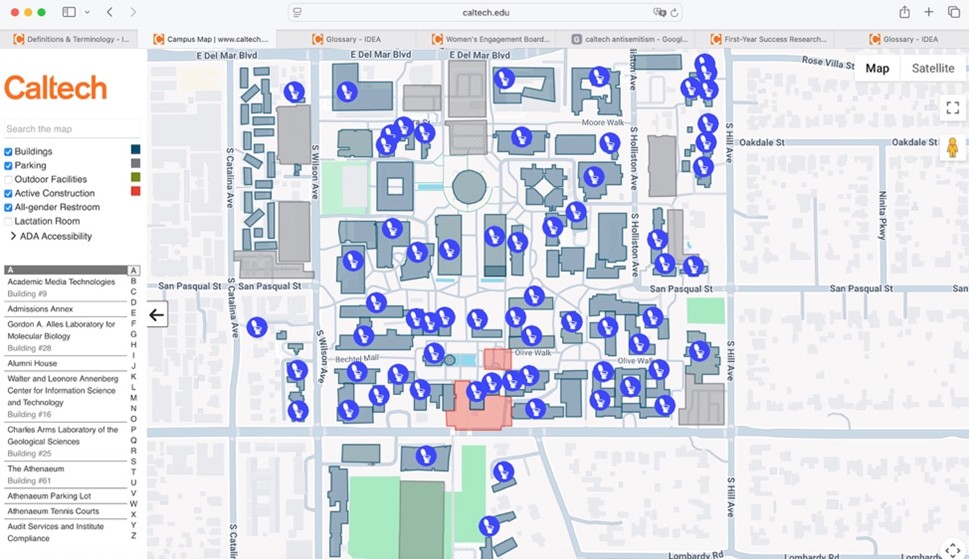
CCID offers a number of DEI “trainings” and “workshops” that are available to departments on campus. The trainings consist of six separate modules, each 75 minutes long, spanning organizational psychology, human resources management, and LGBTQIA+ related topics. The courses themselves include:
Table 1.1: DEI Trainings From CCID69
- Building Common Ground
- Inclusive Leadership 101
- Inclusive Leadership 201
- Inclusive Mentorship
- LGBTQIA+ 101
- LGBTQIA+ 201
- Microagressions and Bias 101
- Microagressions and Bias 201
- Positionality in Research 101
- Positionality in Research 201
When examined individually, each course and training focus on a different component of DEI programming and the ideological paradigm of intersectionality. For example, CCID describes the Building Common Ground workshop as “focusing on participants’ varying identities, perspectives, and social backgrounds.”70 Among the learning outcomes is to “explore and reflect on personal and social identities,” and to “identify examples of personal bias.”71
Trainings devoted to the LGBTQIA+ identity group and microaggressions offer some of the most detailed examples of Caltech’s DEI indoctrination programming. The LGBTQIA+ 201 module exhorts participants to “comfortably address and intervene in moments of potential bias or harm,” and to “identify ways in which you and your lab/department can better the environment and experiences for LGBTQIA+ folx.”72
CCID’s trainings on microaggressions are perhaps the most pernicious of what is offered, as they focus on projected assumptions behind unconscious and subconscious behaviors and expressions. Microaggressions and Bias 101 is described as a place in which “participants will learn how to identify personal biases, recognize how bias manifests itself in their field, and develop strategies to address biases.”73 The follow-up course Microaggressions and Bias 201 assumes that participants carry some form of inherent flaw in their social behaviors and outlook that the training will correct. The course claims that “participants will learn how to identify microaggressions” and that the “session will address the role of social identity, and dive into techniques to disrupt microaggressions, challenge stereotypes, and redirect harmful behaviors.”74 Among the outcomes is to “interpret the intent vs. impact” of microaggressions.75
The concept of microaggressions fills out a nebulous underworld of imagined threats and assault. It emerged in the 1970s with the work of Harvard psychologist Chester Pierce describing the “‘subtle blows’ experienced by Black people that are neither major nor explicit and yet cause real harm.”76 The theory assumes that it is possible to objectively determine the intent behind subtle, “micro” behaviors that are not only acknowledged to be subconscious or unconscious, but are also interpreted through a projected assumption about the individual who exhibits them. This particularly highlights the problem inherent to all DEI “training.” Intent is a private thought and is nearly impossible to determine objectively in normal social interactions, making it a useful tool for social coercion and indoctrination. Caltech’s DEI initiatives venturing into this psychological territory are reminiscent of authoritarian movements throughout history.
CCID makes an effort to tailor its courses to Caltech’s focus on research and education in the hard sciences. CCID’s two courses on Positionality in Research (101 and 201) apply the identitarian ideology of Critical Theory to research in the hard sciences.77 The second course in the module, Positionality in Research 201, includes “crafting a positionality statement.”78 The New Faculty Guide to Teaching at Caltech, offered by the campus’s Center for Teaching, Learning, and Outreach, explains “positionality statements” in more detail and includes guidelines on incorporating instructor self-reflection after teaching. In its section on post-course guidelines, the New Faculty Guide encourages what is tantamount to self-indoctrination. The Guide offers a section titled “Reflecting on your identities and position,” and addresses instructors to envision their own work in the framework of race and gender:
Your teaching emerges from your educational background and training, as well as from your personal history and experience. Reflecting on how who you are and what you have experienced shapes your teaching can help you identify ways to better connect with your students. Positionality refers to the social, cultural, and political contexts – including systems of power and oppression – that shape our identities. Our positionalities influence how we approach course design, choose content, teach, and assess student work. Recognizing how your own positionality impacts your teaching can help you create a more inclusive classroom. On one level, intersectionality refers to the ways that the multiple dimensions of our identity intersect to shape our experience. Black feminist scholars have stressed how social systems based on things such as race, class, gender, sexual orientation, and disability combine to create an interlocking system that privileges some and oppresses others. Reflecting on your own positionality and the intersectional nature of your identity can help you think more intentionally about your content choices, the materials you assign to your students, and even how the different aspects of your students' identities may affect their experience in your class.79
While the CCID’s resources and guidelines seek to integrate DEI indoctrination into teaching and administration, it similarly offers resources for reinforcing these ideas among students. Caltech’s CCID also states that it can “provide funding for a Caltech department, employee resource group, or registered student organization to execute a program, event, or resource that aligns with the CCID’s mission and values.”80
CCID’s efforts to shape and control perception through a combination of social pressure and “self-reflection” are reminiscent of psychological tactics used by Communist regimes in the Soviet Union and China. Joseph Stalin’s works, The Foundations of Leninism, and Against Vulgarising the Slogan of Self-Criticism, both published in the 1920s, expound on this psychological tool of indoctrination in detail. In the second work, Stalin opens by saying that the “slogan of self-criticism must not be regarded as something temporary or transient…Self-criticism is a specific method, a Bolshevik method.”81 Drawing from Karl Marx and VI Lenin, Stalin expounds on the purpose of “self-criticism” at length as a way to reshape the individual’s orientation away from pre-existing “bourgeois” culture and towards revolution. DEI’s ideological premise is that “White Supremacy” is a pervading cultural phenomenon that permeates numerous aspects of life and that race is an essential component of an individual’s makeup. DEI translates these Marxist ideas from class struggle to broader aspects of a racial and cultural struggle.
Caltech’s Hixton Writing Center offers hands-on guidance for members of the Caltech community crafting diversity statements for new academic positions.82 Addressing writers, the Guide encourages those applying for professorships, fellowships, and graduate school to demonstrate:
- How background and experiences shaped understanding of “diversity, equity, and inclusion”
- “Understanding of the barriers that historically excluded groups have faced in higher education, your specific field, and the broader community”
- “Your commitment to dismantling these barriers and increasing diversity in higher education, your specific field, and the communities of which you are a part”
- And “your contributions and plans to support and foster diversity in your field, university, and community.”83
The Hixton writing guide also links to Caltech’s library website, which features a dedicated webpage on DEI.84 The Caltech Library offers resources such as “Anthologies About Diversity,” “Building Cultural Competence,” “Inclusive Teaching,” “Building Diversity and Inclusion in Higher Education,” “Diversifying STEM,” “Building Diverse and Inclusive Workplaces,” and “Writing Your Diversity Statement.”85
CCID Resources for Students
CCID takes a hands-on approach to implementing DEI whenever possible for students attending the university. CCID currently offers two “Signature Programs” devoted to DEI that are “cohort-based” and “coordinated” by CCID personnel over the course of an academic year.86 These two programs include the First-Year Success Research Institute (FSRI) and the Mellon Mays Undergraduate Fellowship (MMUF).87 While the FSRI program’s webpage makes no mention of DEI, the MMUF explicitly mentions DEI in its programming. Caltech’s information page for the MMUF states that it is “committed to supporting a diverse professoriate and to promoting the value of multivocality in the humanities and related disciplines, elevating accounts, interpretations, and narratives that expand present understandings.”88
Beyond fellowships, CCID offers several “Affinity Groups” for students. CCID notes that it “hosts several affinity spaces each year,” and that “these spaces are designed to foster a sense of community and promote a feeling of belonging for all members of the Caltech community.”89 These Affinity Groups include the Black Ladies Association of Caltech (BLAC), the Women’s Engagement Board, and First-Generation Students at Caltech.90 These Affinity Groups are listed separately from, but included in, the numerous student organizations that are centered on identity on campus.
Table 1.2: Student Groups Advertised by Caltech’s Center for Inclusion and Diversity91
- Asian/Asian American, Pacific Islander, and Desi American (APIDA+)
- Black Ladies Association at Caltech
- Black Scientists and Engineers of Caltech (BSEC/NSBE)
- Black Student Union (BSU)
- Caltech Hispanic Latino Association (CHLA)
- Club Latino
- PRISM
- Caltech Society of Women Engineers (SWE).
Caltech’s array of student identity groups is noteworthy, given the university's overall demographics, with multiple groups catering to proportionally small sub-populations within the student body. It is also worth noting that these student affinity groups are not the organic, voluntary associations that typically occur in student life beyond the auspices of Caltech’s formal administration, but rather affinity groups built into the institution.
DEI-themed events hosted by these respective groups vary considerably. For example, CHLA describes itself as “committed to advancing Latinx undergraduates in their future careers as scientists and engineers.”92 Along with Club Latino, which is centered on Caltech’s Hispanic graduate students, CHLA is geared towards networking and “providing STEM demonstrations” for local K-12 schools.93 In contrast to the profession-focused programming offered by CHLA and Club Latino, APIDA+ is more explicit in its integration of DEI themes into its activities. For example, APIDA+ describes its goals as to “educate the Caltech community about historical and contemporary APIDA issues,” offer an “affinity space for APIDAs as part of the identity formation process,” “spotlight the intersection of APIDA identity with other identities (i.e., gender & sexuality, disability, religion, multi-racial APIDA identity, immigration status, etc.),” and to facilitate “mutual allyship between APIDAs and non-APIDAs.”94
This year, Caltech opted to remove, reduce, and re-label DEI-related language across the institution while retaining DEI programming. This past April, Caltech renamed the title of its main DEI officer as the “associate vice president for campus climate, engagement, and success.”95 Despite the renaming, CCID continues to host DEI-related events and continues to offer DEI resources.96 In the rebranding, Caltech president Thomas F. Rosenbaum reaffirmed commitment to DEI without using the term. Rosenbaum stated:
Finally, I am delighted to announce the promotion of Lindsey Malcom-Piqueux to associate vice president for campus climate, engagement, and success. In this expanded capacity, Lindsey will be responsible for promoting engagement, progression, and personal and professional success within the Caltech community. She is charged with further cultivating a community in which all students, postdoctoral scholars, faculty, and staff have a sense of belonging and are supported as they pursue their academic, career, and institutional goals.
Lindsey will continue to work with colleagues across the Institute to develop new research-based initiatives to achieve these goals. These collaborative efforts will facilitate organizational learning and capacity-building to supporting the entire Caltech community, with an emphasis on students and postdocs. Lindsey will be responsible for CCID, including FSRI, the Office of Institutional Research, the research university alliance group, and the office of Career Achievement and Leadership Exploration (CALE). Claire Ralph, director of CALE -- and her group – will join Strategy Implementation on April 1. In this way, Lindsey's remit will be to bolster robust professional development, mentoring, and networking opportunities for students and postdoctoral scholars from admittance, matriculation, and graduation, into early career stages, inside or outside of the academy. Caltech will not remain competitive in the long term without a steadfast commitment to inclusive excellence.97
Caltech’s performative administrative change coincided with a similar rebranding at the National Aeronautic and Space Administration’s (NASA) Jet Propulsion Lab (JPL), which Caltech hosts and administers.98 In 2024, JPL cut roughly 900 staff, yet retained its chief DEI officer, Neela Rajendra.99
Chapter 2: Strange Bedfellows: International Students, Federal Funding, and DEI’s Survival at Caltech
The actual diversity at Caltech that lies beneath the university’s ideologically driven DEI efforts is difficult to unpack due to how campus demographics are tracked. This is doubly true when international students are taken into account. Due to the eagerness of universities to attract a greater number of students from abroad, American students are being crowded out of top US institutions, such as Caltech. While both DEI and the rising prevalence of international students raise concerns over civil rights protections at Caltech, tensions between the scope of Caltech’s international student body and its own DEI efforts underscore a deeper conflict that receives little attention: where international students fit into the nexus of intersectionality inherent in the DEI agenda.
In 2020, the Black Scientists and Engineers of Caltech (BSEC) issued a letter (supported by twenty-six allied campus organizations) to Caltech’s administration complaining about the opacity of the university’s demographic data.100 The specific concern was that by aggregating international students into the university's demographic data as a single group, American black students were being shortchanged: “<1% of Caltech students are Black.” This practice systematically disadvantaged “racially minoritized students,” and the BSEC sought redress through six demands, including disaggregating “underrepresented Minority” enrollment statistics and using the disaggregated demographic data to restructure “institutional diversity efforts.” Accompanying this were demands for more DEI funding, increasing racial segregation (“cohort-building … for racially minoritized students”), ideological litmus tests (new fellowships for “students committed to increasing diversity”), which it was paradoxically asserted would “reduce racial bias in graduate admissions.”
Like other top-tier science and technology schools, Caltech's campus community comprises a sizable demographic of international students and faculty.101 According to Caltech’s own Fall Enrollment statistics for 2024-2025, “international students” respectively comprise 14% of undergraduates and 47% of graduate students.102
Table 2.1: 2024-2025 Caltech Enrollment Demographics
|
Undergraduate |
Graduate |
||||||
|
Total |
987 |
Total |
1443 |
||||
|
Self-Identified Sex |
# Students |
% |
Self-Identified Sex |
# Students |
% |
||
|
--- Female |
446 |
45% |
--- Female |
525 |
36% |
||
|
--- Male |
541 |
55% |
--- Male |
918 |
64% |
||
|
Ethnicity and Race* |
# Students |
% |
Ethnicity and Race* |
# Students |
% |
||
|
Total |
987 (230) |
Total |
1443 (152) |
||||
|
--- American Indian or Alaska Native |
18 (17) |
2% |
--- American Indian or Alaska Native |
14 (13) |
1% |
||
|
--- Asian American |
438 (85) |
44% |
--- Asian American |
250 (54) |
17% |
||
|
--- Black or African American |
80 (34) |
8% |
--- Black or African American |
47 (25) |
3% |
||
|
--- Hispanic/Latinx |
172 (141) |
17% |
--- Hispanic/Latinx |
105 (83) |
7% |
||
|
--- Native Hawaiian or other Pacific Islander |
13 (12) |
1% |
--- Native Hawaiian or other Pacific Islander |
(8) |
1% |
||
|
--- White |
378 (193) |
38% |
--- White |
507 (132) |
35% |
||
|
--- International |
140 |
14% |
--- International |
671 |
47% |
||
|
--- Race/ethnicity unknown |
1 |
<1% |
--- Race/ethnicity unknown |
3 |
<1% |
Notable about Caltech’s demographic data is the overall size of the campus’s international student body, which accounts for approximately 33% of the student body. When international undergraduate and graduate students are combined, they comprise the third largest “racial” demographic after Asian and white students. Disaggregated, international students make up the largest “racial” demographic among graduate students. Caltech itself notes that its own statistics do not collect ethnic and racial data on international students, and yet includes “international” students as a racial and ethnic category.103 Statistics from non-campus-affiliated entities corroborate these numbers.
According to Admission Sight, which tracks admissions statistics, the majority of Caltech’s international students come from China, India, and Canada.104 Other data, compiled by College Factual, places international students as the largest overall ethnic demographic among undergraduates, at 31%, surpassing the Asian and white student populations.105 College Factual similarly notes that more than 47% of Caltech’s graduate student population is comprised of international students, and is again the largest “ethnic” demographic, while dwarfing the American white and Asian student categories, which respectively stand at 32.5% and 10.5% of the student population.106
Within the international student body, Chinese students are the largest group, representing 27% of the total.107 Additionally, the number of Chinese students at Caltech is thought to be growing by an “average rate of 10.3%” per year.108 India is the runner-up, accounting for roughly 9.1% of international students at Caltech; however, this group is growing at an average rate of 8%.109 Canadian students are the third-largest group, representing approximately 8.9% of international students, with a growth rate of 7.3% per year.110
Caltech also has a program for international students who are refugees. As a founding member of the “Global Student Haven Initiative,” a collection of universities that “aims to support more effectively student refugees from around the world,” Caltech commits to “helping displaced students overcome the barriers to the application process.”111 Caltech similarly offers its refugee students “need-based financial aid that meets 100% of their demonstrated financial need.”112
The prominence of foreign students, as well as their inclusion as a collective ethnic category in Caltech’s student data, highlights two profound problems not only for the university but also for civil rights, national defense, and overall integrity. Caltech’s first problem is its ostensible commitment to diversity and supporting students from “historically underrepresented” demographics in the US. This is simply tantamount to ideological hypocrisy considering Caltech’s DEI efforts over the past decade, and compounds the problem of Caltech’s rebranding of DEI as federal officials seek to reimpose merit-based programming in higher education. Caltech’s own diversity-driven enrollment efforts are thus tantamount to false advertising and a form of fraud.
At a deeper level, the prevalence of foreign students at the graduate level, in which they comprise nearly half of Caltech’s graduate population, raises the possibility of discrimination against American citizens. Earlier this year, the US Department of Education’s Office of Civil Rights (OCR) opened investigations into the University of Louisville, the University of Nebraska at Omaha, the University of Miami, the University of Michigan, and Western Michigan University over potential discrimination against American citizens in scholarships that were given to illegal immigrants.113 The Civil Rights Act of 1964 prohibits discrimination based on national origin. While the issue of international student admissions is arguably more complex and less explicitly addressed, Caltech’s high percentage of enrolled foreign students, particularly in graduate education, raises questions about whether Americans are simply not meeting admissions requirements or whether they are being actively passed over for foreign competitors.
Recent studies rank STEM education in American schools as mediocre. According to the Organization for Economic Cooperation and Development, the US ranked 28th out of 37 developed countries in math and 12th in science.114 According to rankings calculated by WalletHub (where Caltech is based), California ranks below average in the quality of its school system compared to other states.115 Unlike state schools, which charge higher tuition fees for foreign students, Caltech’s tuition fees are uniform.116 Without the financial incentive for Caltech to take higher proportions of international students, the question remains whether the university is discriminating against Americans in its graduate admissions. Several studies have similarly ranked California as the most culturally diverse state in the country. Yet, the proportion of international students in Caltech’s graduate programs raises questions about whether or not the university’s DEI efforts amount to little more than virtue-signaling admissions theater.117
National security, not racial quotas, is a more pressing aspect of Caltech’s international student body. Caltech receives considerable government funding for research in defense, and more broadly, strategically sensitive technologies related to artificial intelligence, biotechnology, advanced materials, and space. Universities working in sensitive technologies, as well as universities in general, are easy targets for foreign influence and technology transfer through the guise of fundamental research, hacking, and other means. Numerous recent cases of Chinese espionage activity at major American universities highlight the danger. This year alone, federal authorities made multiple arrests of Chinese researchers at the University of Michigan over the alleged smuggling of dangerous biological materials.118 This May, a Chinese intelligence network was uncovered at Stanford University involving sensitive technologies.119 Caltech is a prime target for such espionage.
Caltech currently receives considerable amounts of federal funding; yet, its commitment to DEI, the prevalence of foreign students, and the Trump administration’s cost-cutting efforts targeting indirect costs in government grants have converged over the past year to threaten the university’s finances.120 In 2024, Caltech received over $221.7 million in federal grants, in addition to the $2.5 billion the university’s Jet Propulsion Laboratory receives for its work with NASA.121
On the issue of DEI, Caltech rebranded its diversity head while retaining the institutional aspects of DEI on campus. Caltech renamed the position of Assistant Vice President for Diversity, Equity and Inclusion, held by Lindsey Malcom-Piqueux, as the Vice President for Campus Climate, Engagement, and Success.122 Despite the superficial masquerade, Caltech’s Center for Inclusion and Diversity (CCID) is alive and well on campus under the banner of “IDEA” (Inclusion, Diversity, Equity, and Accessibility).123
Campus DEI events similarly continue unperturbed by the rebranding. Events such as “Affinity Spaces,” the “STEMinar Series,” “Dine and Dialogue,” “Unpacking Hate,” and a “Celebration of Excellence” are a few examples of active DEI programming that incorporate identity politics into research and scholarship, despite Caltech’s performative changes.
CCID describes its “Affinity Spaces” as a place where they:
Brought together community members who are first-generation college students and graduates, folx and allies of the LGBTQIA community, People of Color, Women of Color, Graduate & Postdoc, Postdocs from Historically Excluded communities, Men of Color, Agender, Non-Binary, and Gender-Expansive Indentities, and members of Southeast Asian and North African (SWANA)/Middle Eastern community, to name a few.124
Despite the tacit exclusion of straight white or Asian men, CCID’s Affinity Groups webpage carries a perfunctory declaration that “Affinity spaces are open to anyone in the campus community, regardless of race, national origin, gender identity, sexual identity, and/or any other protected characteristic.”125
While Affinity Spaces is marketed more as a social experience, Caltech’s “STEMinar Series” is more explicit in its preference for racializing research. CCID describes the STEMinar Series to “highlight scholars working to advance inclusion, diversity, equity, and accessibility in the scientific community.”126 CCID states that:
We invite STEM faculty, scholars, and experts to explore the intersections of their various identities, advocacy, and activism with their science. Your participation is crucial in shaping the future of STEM. We hope that community members will be empowered to explore their own path in the world of STEM and reflect on how their science interacts with their identity.127
The notion of identity-specific science is inherently contradictory, as scientific discoveries made across time and space are equally relevant, regardless of who makes them. Mathematics, for example, has drawn from oriental, Greek, Islamic, and European cultures over centuries: the Pythagorean theorem unites them all.
Caltech’s “Celebration of Excellence” program is closely related to the STEMinar Series and institutionally rewards the racialization of Caltech’s work. By now, the “Celebration of Excellence” has become an 18-year tradition at Caltech, which the CCID describes as honoring:
… members of our community who exemplify leadership and excellence in advancing inclusion, diversity, equity, and accessibility (IDEA) on campus and in the greater community. We continue to be grateful for the members of the campus community who work to advance IDEA initiatives and efforts at Caltech and beyond.128
The Celebration of Excellence is a series of awards that institutionally support and praise individuals who advance the DEI agenda. These awards include:
- The IDEA Allyship & Advocate Award: This award is given to individuals who promotes the needs and experiences of all members of the Caltech community. Such actions include raising awareness, cultivating an inclusive environment, and advocating for a fair campus climate.
- The IDEA Outreach and Education Award: This award is given to individuals who teach and inspire interest in inclusion, diversity, equity, and accessibility in the community at large through learning experiences and service. This person takes the initiative to participate in civic engagement through volunteerism, service-learning, and teaching initiatives as a change agent in the community outside of Caltech.
- The Candace Rypisi Outstanding Mentor Award: This award is given to individuals who are willing to share knowledge and enhance their mentee's professional and personal development. This person has provided emotional and moral support and encouragement while improving or helping facilitate access to career-related information and exposure to various professional resources. This awardee is someone who actively promotes their mentee's sense of competence, confidence, and belonging.
- The CCID Agent of Change Award: This award is given to individuals embodying servant leadership through a demonstrated commitment to steering institutional change within the Caltech community. This person takes the initiative and has the vision to translate a need into actionable steps or policy to create a legacy and a more inclusive campus climate.
- The CCID Activist Scholar Award: This award is given to individuals who demonstrated excellence within their discipline and research while engaging in complex societal issues. This awardee has led or participated in advocacy campaigns centering on ensuring fairness, developed programs or activities expanding opportunities, and provided vision and leadership in forming systems of support for everyone.
- The Houses and Residences IDEA Award: The Houses and Residences IDEA Award celebrates exceptional individuals who excel in fostering a vibrant and inclusive environment within the Houses and Residences. Their unwavering commitment ensures that each resident feels a deep sense of belonging and support. These leaders drive positive transformation by nurturing inclusive dialogues and instilling a strong sense of community through their advocacy. Through their efforts, they create an environment where everyone can flourish in Houses and Residences.
- The Inclusive Laboratory Engagement Award: The Inclusive Laboratory Engagement Award celebrates exceptional individuals who excel in their discipline and in fostering a vibrant and inclusive environment within the graduate student and/or post-doc community, particularly in the laboratory setting. They strive to ensure that each person feels a deep sense of belonging and support. These leaders foster an environment for collaborative research and learning. Through their efforts, they create an environment where everyone can thrive in their academic and research pursuits.129
CCID’s “Dine and Dialogue” event is designed as an ideologically driven social space that more explicitly promotes DEI. Known previously as “Dish and Discuss,” the CCID describes Dine and Dialogue events as a:
Platform to discuss topics that are directly relevant to our community, such as inclusion, diversity, equity, accessibility, and social justice. The series aims to bridge the gap between current themes at Caltech and broader societal issues, fostering a sense of connection and engagement. The Dine and Dialogue program has delved into a diverse array of topics, including Black Feminist Thought, Oppression Olympics, and Cultural Appropriation.130
CCID’s “Unpacking Hate” programming is quarterly and overtly political, designed to address the “broader social, political, and historical context of intergroup antagonism.”131 The Unpacking Hate series links Caltech’s DEI efforts with social justice off-campus, as the events are “usually in collaboration with a group or organization outside of Caltech.”132 CCID describes the events as centered on:
Unpacking the complexities of hate within our society through speakers who are experts in their experience and field. The goal is for the Caltech community to gain the tools to disentangle the way that hate manifests in our society and be empowered to challenge how systems and communities continue to uphold systems of oppression. The Unpacking Hate series has delved into a diverse array of topics, including Anti-Blackness, Misogynoir, Antisemitism, Homophobia, Islamophobia, Transphobia, Anti-DEI, and Colonialism to name a few.133
Unpacking Hate has worked with the California Council of Cultural Centers in Higher Education (CCCCHE).134 Formed in 1994, the CCCCHE is a hub of social justice activism and describes itself in pseudo-revolutionary terms:
We stand staring into the changing face of America’s future. California will be the first to decide whether to communicate across the cultural divide, effectively managing our differences, or steer the nation into a state of collision.135
In sum, these events indicate not only DEI’s survival at Caltech but also how Caltech’s administration is thoroughly saturated with DEI’s broader ideological agenda. Caltech’s programming through CCID, combined with the prevalence of international students in lieu of American students from minority backgrounds, highlights the hypocritical and ideological nature of Caltech’s DEI efforts.
Campus Anti-Semitism and DEI at Caltech
Background
The Hamas attack on southern Israel on October 7, 2023 was not only the worst terrorist attack in Israeli history, but it also instigated the largest murder of Jews since the Holocaust.136 Following the attack, protests against Israel ensued across American college campuses, along with a rise in nationwide anti-Semitism.137 Pro-Palestinian encampments, faculty statements, and event assaults and the takeover of campus buildings have led to Congressional hearings on anti-Semitism in higher education and lawsuits. This section examines how Caltech’s DEI programs have grappled with anti-Semitism since the October 7th attack in light of diversity initiatives coming under greater national scrutiny and DEI’s awkward history in addressing anti-Jewish campus sentiment.
DEI Has an Anti-Semitism Problem
Despite its ostensibly inclusive label, DEI has proven integral to the same identity politics that help fuel today’s anti-Semitism. While originally couched in anti-discrimination laws that conformed to the Civil Rights Act, “diversity” initiatives have grown into bureaucratized efforts to promote grievance-based identity politics across universities. Despite its anti-Zionist mask, today’s campus anti-Semitic activism revolves around the same identity-based campus politics that permeate the broader DEI agenda.138 In 2021, there were roughly 3.4 DEI staffers nationwide on college campuses for every 100 professors, and 4.2 times as many diversity staff devoted to serving those with disabilities.139 A study of Twitter feeds of 741 DEI staffers across 65 universities found them overwhelmingly condemnatory of Israel, while generally favorable to well-known human rights abusers such as China.140 While campus anti-Semitism has captured negative headlines for schools like UCLA and the Ivy League, the story of anti-Semitism at Caltech and DEI’s awkward efforts to combat it are less well-documented.
Anti-Semitism at Caltech before and since October 7
Prior to October 7, Caltech had hosted a number of high-profile Jewish scientists. Between 1931 and 1933, Albert Einstein served as a visiting professor at the Institute before accepting a position at Princeton.141 The Jewish seismologist Beno Gutenberg, who helped develop the Richter Scale, came to Caltech in 1930.142 Similarly, Robert Oppenheimer held a half-time professorship at Caltech (shared with UC Berkeley). Several of Caltech’s prominent scientists are Jewish. It is safe to say that Caltech has historically been a friendly environment for Jewish scientists, many of whom have contributed significantly to the university's academic reputation through their outstanding research.
Despite Caltech’s historical commitment to excellence, it nonetheless adopted DEI into its institutional framework and the identity politics that comes with it.
Caltech had issued statements prior to October 7, 2023, about anti-Semitism both on and off campus. In 2022, Caltech's president issued two statements on anti-Semitism, with the first in response to the synagogue hostage crisis in Colleyville, Texas, and the second in response to anti-Semitic graffiti on campus. The two incidents offer an insight into how DEI, with intersectionality as its ideological core, has changed Caltech’s approach to anti-Semitism.
In January 2022, a Pakistani British man named Malik Faisal Akram took four people hostage at a synagogue in Colleyville, Texas.143 The ensuing standoff with Texas authorities lasted 10 hours before hostages escaped and Akram was killed by police.144 Akram made demands for the release of a terrorist named Aafia Siddiqui.145
Despite the obvious Islamist connection to what was an anti-Semitic act of mass murder, Caltech’s administration covered up these facts when interpreting it to the campus community. In response to the attack, President Thomas F. Rosenbaum made no mention of the university’s DEI office. Instead, Rosenbaum alluded to the attack as a problem with American society. Rosenbaum stated:
As I talk to other university presidents around the country about the events in Colleyville, Texas and their effect on our campus communities, a primary theme that emerges is the need to teach history and establish context. The old adage proclaims that those who cannot remember the past are doomed to repeat it. Especially for our students who may not have a visceral feel for the Jewish diaspora of the 19th and 20th centuries, from pogroms to the Holocaust, history provides at least a partial means to come to grips with the trauma of hostages held in a house of worship on the Sabbath day, a travesty emblematic of the rapid rise in violent anti-Semitic attacks around the world…Yet, as much as we stress the benefits of learning in a diverse community, where we value others for their individual life stories, experiences, and perspectives, I fear that we do not understand sufficiently deeply the attention that must be paid to resist the societal inclination to devalue the other, to stereotype human beings who do not share our personal background or experience. We see this in Colleyville, we saw this in Charlottesville and Minneapolis, and we will see it again… I am disappointed, but not surprised, to see virulent anti-Semitism rear its ugly head, even in the United States. It is my profound hope that the Caltech community can draw strength from the lessons of the past to counter the current trends of polarization and intolerance, and to act together to create the conditions where every member of our community can thrive.146
Rosenbaum’s response conveniently glossed over the fact that the Colleyville terrorist, Akram, was a foreign national motivated by jihadist ideology, as well as the fact that he was on foreign intelligence watch lists. This kind of omission bias is rampant in higher education, as it supports the narratives about “systemic racism” in the United States upon which the DEI agenda thrives.
Later in 2022, Rosenbaum responded to an incident on the Caltech campus involving “racist and antisemitic speech drawn in marker on a bathroom stall in the WM Keck Engineering Laboratories building.”147 While Rosenbaum issued a statement about “hate speech” and implored “all members of our community to remain vigilant in rejecting hate speech in all its forms,” he encouraged students to reach out to Student Counseling Services, and faculty to reach out to the campus’s Staff and Faculty Consultation Center.148 Both of these campus offices offer mental health resources and professional counseling. However, it is unclear as to what specific solutions Caltech’s CCID offers that these other resources do not.
On October 12, 2023, Caltech president Rosenbaum issued a campus-wide statement on the Hamas attack that notably addressed anti-Semitism along with the “dehumanizing, denial of the Jewish people’s right to self-determination.”149 In a statement titled “Rejecting Hate Speech,” Rosenbaum condemned anti-Semitic social media posts and emails that were “directed to members of the Caltech community.”150 Rosenbaum condemned the online rhetoric as “these expressions of hate and prejudice,” and declared that Caltech seeks to foster an “inclusive environment where all can express their views in ways that respect one another.”151 That November, Caltech’s CCID held an event titled “Unpacking Hate: Disrupting Antisemitism,” as part of a “quarterly series addressing the broader social, political, and historical context of intergroup antagonism.”152 As California colleges go, Caltech did not witness the same kinds of clashes as those at nearby UCLA in the ensuing campus protests; however, the campus’s tensions do raise questions about the relevance of Caltech’s DEI programs.
In April 2024, students affiliated with the anti-Israel group, Students for Justice in Palestine (SJP), staged a “Silent Sit-In” to “Protest Caltech’s Silence Towards the Palestinian Genocide.”153 The SJP chose Caltech due to what it claimed as its “affiliation with the military industrial complex” and due to the relative lack of pro-Palestinian activism on campus.154 The sit-in was accompanied by a march of approximately 100 people, which included Caltech students and off-campus community members, such as the group Pasadena for Palestine.155 Campus marchers shouted slogans such as “Caltech, Caltech, pick a side, justice for genocide,” and “Your hands are bloody too.”156 Ironically, SJP itself nodded to diversity when organizing a rally close to campus, stating in a campuswide email that it:
As we write this, Gaza is suffering a near-total shutdown of all internet and cellular services as the Israeli military forces prepare for a ground invasion. We cannot stay silent as we watch this genocidal war unfold. We, Caltech SJP, whose members come from diverse backgrounds and experiences, proudly stand in full solidarity with the Palestinian anti-colonial struggle for liberation.157
One Jewish undergraduate student involved with Hillel noted that Caltech’s administration blocked SJP from formally operating on campus; instead, some of the anti-Israel activism was instead supported by the student group, Socialists of Caltech.158 The student also stated that the Socialists of Caltech receive campus funding.159
In response to the protests, Caltech president Rosenbaum announced that the university updated the campus’s “Free Speech and Expression Policy.”160 Rosenbaum stated that:
College campuses across the country have been roiled by protests over Gaza, raising fundamental issues involving freedom of expression, hate speech, and campus safety. With these challenges in mind, Institute leaders recently reviewed and updated Caltech’s Free Speech and Expression policy… A robust, intellectual debate is essential to our democracy and, more specifically, foundational for a college campus where new knowledge is created by bringing together diverse individuals to express their views freely and, in colloquy, shape each other's ideas. Caltech is committed to the free exchange of ideas and recognizes that, in a diverse and thoughtful community, there will be conflicting beliefs and opinions.
It is not the role of the Institute to attempt to shield people from ideas and opinions they find unwelcome, disagreeable, or even deeply offensive, and the expression of objectionable speech on its own is not grounds for silencing. At the same time, the Institute has an obligation to protect the safety and well-being of all Caltech community members and has a responsibility to implement policies that enable the Institute and its actors to do so.161
Caltech’s “Free Speech and Expression” policy notably makes no mention of “hate speech” or social media postings. In contrast, Caltech’s Unlawful Harassment and Abusive Conduct policy does address workplace issues related to racial and insensitive comments without using hate speech as a term.162
Caltech’s Unlawful Harassment and Abusive Conduct policy recommends that students and faculty concerned about campus conduct contact the university’s Equity and Title IX office.163 Notably, Caltech’s Title IX office is a separate layer of DEI administrative bureaucracy from CCID.164 This raises questions about CCID’s relevance beyond ideological programming based on identity politics, as well as concerns about Caltech’s allocation of campus resources.
While Caltech was spared mass campus takeovers, riots, and threats that characterized places like UCLA and the Ivy League, CCID’s response to anti-Semitism and concerns of Jewish students highlights DEI’s ideological nature and inability to address deeper campus divisions. One undergraduate student and one faculty member involved with Caltech’s on-campus Jewish life noted that CCID fell short in offering an effective response to concerns about anti-Semitism and safety. According to the student, CCID was unresponsive when given concrete suggestions about anti-Semitism, and did nothing to help organize campus security for a Shabbat dinner. In contrast, CCID did organize back-to-back seminars on anti-Semitism and Islamophobia, the “moral equivalence” fallacy.165 According to a student active in Hillel, Israeli students were frustrated about how CCID could never condemn anti-Semitism without condemning Islamophobia at the same time.166 One Jewish faculty member stated that he felt it was important for CCID to condemn Islamophobia due to Caltech’s sizable Jewish campus population, but that CCID seemed to lack “the expertise” in dealing with anti-Semitism.167 CCID’s awkwardness in addressing anti-Semitism can only be explained by DEI’s ideological basis and its premise of intersectional victim groups.
Conclusion and Recommendations
In light of a duplication of effort between Caltech’s DEI programs alongside campus counseling and Title IX administration, as well as DEI’s questionable legality, Caltech’s DEI bureaucracy, labeled as IDEA, is arguably both ideologically driven and redundant. Additionally, due to the prevalence of international students at Caltech, the campus’s commitment to representing minority Americans at one of the world’s top STEM institutions is remarkably hypocritical. Furthermore, Caltech’s ostensible relaunch of its DEI programs as IDEA, housed within CCID, demonstrates that the university’s move away from identity-based policy is disingenuous.
Based on this survey of Caltech’s approach to the diversity agenda, we make the following recommendations:
- Close the Center for Inclusion and Diversity. We recommend the full closure of CCID and a complete elimination of its staffing and positions. CCID’s operations and Caltech’s explicitly stated commitment to diversity both antithetical to merit and hypocritically executed. Tacitly dividing students and faculty along racial lines via “affinity” groups and specialized programming is diametrically opposed to campus cohesion and the professional camaraderie that scientific advancement and exploration requires. Furthermore, the philosophy that underpins DEI is contrary to the spirit of civil rights law as well as the spirit of merit and professional camaraderie that is conducive to scientific inquiry.
- Increase the admissions of American students in relation to international students and open more nontraditional pathways to Caltech admission. Caltech’s proportion of international students within its overall student body, particularly at the graduate level, raises problematic questions about the security of dual-use technologies from fundamental research, and about the university’s interest in helping young Americans of different backgrounds reach scientific excellence. Caltech should open more nontraditional pathways for students who supersede the ordinary requirements of American high schools in science and math. The US school system may lag behind schools abroad, and expanding Caltech’s influence and access into Southern California’s schools is one way to contribute to the country’s educational advancement.
An analysis of Caltech’s enrollment demographics and commitment to the DEI agenda reveals that the university’s identity-based programs, administered through CCID, are both ideologically driven and poorly implemented. Caltech should restore full merit and the professionalism of colorblindness by relegating its DEI programs to the history books.
1 Jonathan Wai and Steve Hsu, “These 25 Schools are Responsible for the Greatest Advancements in Science,” Quartz, July 20, 2022, (https://qz.com/498534/these-25-schools-are-responsible-for-the-greatest-advances-in-science), accessed July 5, 2025.
2 “Caltech’s Quantum Leaper,” Caltech Archives and Special Collections, Caltech official website, (https://library.caltech.edu/c.php?g=1245803&p=9121128), accessed July 5, 2025.
3 Peter Wood, “Caltech Competes,” National Association of Scholars, April 14, 2009, (https://www.nas.org/blogs/article/caltech_competes), accessed July 5, 2025.
4 About page, Caltech Center for Inclusion and Diversity official website, (https://ccid.caltech.edu/about), accessed July 6, 2025. See also Caltech IDEA, (https://inclusive.caltech.edu/about), accessed July 6, 2025.
5 “Build Community,” Caltech Center for Inclusion and Diversity official website, (https://ccid.caltech.edu/buildcommunity) accessed July 12, 2025
6 “Caltech Names Thomas F. Rosenbaum as New President,” Caltech official website, Oct. 24, 2013, (https://www.caltech.edu/about/news/caltech-names-thomas-f-rosenbaum-new-president-40887), accessed Aug. 19, 2025.
7 Ibid.
8 Thomas F. Rosenbaum Inaugural Address, Caltech official website, (https://president.caltech.edu/speeches-and-writings/speech-transcripts/inaugural-address), accessed Aug. 20, 2025.
9 Ibid.
10 “Q &A With Dr. Rosenbaum,” Summer 2014 Issue of E&S Magazine, Caltech official website, (https://president.caltech.edu/about/q-and-a), accessed Aug. 20, 2025.
11 Ibid.
12 Committee on Naming and Recognition, Caltech Diversity, Equity and Inclusion official website, (https://web.archive.org/web/20210115172001/https://inclusive.caltech.edu/about/commitments-progress/committee), accessed July 16, 2025.
13 Statement from Caltech President Thomas F. Rosenbaum, Caltech Diversity, Equity, and Inclusion official website, (https://web.archive.org/web/20210115172833/https://inclusive.caltech.edu/about/commitments-progress/committee/statement), accessed July 16, 2025.
14 “Creating a More Inclusive Caltech,” Caltech Magazine, Fall 2020, (https://magazine.caltech.edu/post/scientists-and-engineers-share-their-experiences-and-perspectives-on-how-to-create-a-more-inclusive-caltech), accessed Aug. 20, 2025.
15 Statement from the Board of Trustees, Caltech IDEA official website, (https://inclusive.caltech.edu/leadership-administration/statement-from-the-board-of-trustees), accessed July 16, 2025.
16 Statement from Thomas F. Rosenbaum, Cultivating IDEA official website, (https://inclusive.caltech.edu), accessed July 16, 2025.
17 “CCE Charts Path in Diversity, Equity, and Inclusion,” Caltech official website, (https://www.caltech.edu/about/news/cce-charts-path-in-diversity-equity-and-inclusion), accessed July 17, 2025.
18 Ibid.
19 “CCE Charts Path in Diversity, Equity, and Inclusion,” Caltech official website, (https://www.caltech.edu/about/news/cce-charts-path-in-diversity-equity-and-inclusion), accessed July 17, 2025.
20 Ibid.
21 Ibid.
22 Ibid.
23 Committee on Naming and Recognition, Caltech Diversity, Equity and Inclusion official website, (https://web.archive.org/web/20210115172001/https://inclusive.caltech.edu/about/commitments-progress/committee), accessed July 16, 2025.
24 Committee on Naming and Recognition, Caltech Diversity, Equity and Inclusion official website, (https://web.archive.org/web/20210115172001/https://inclusive.caltech.edu/about/commitments-progress/committee), accessed July 16, 2025.
25 Ibid.
26 Hales, Thomas (February 19, 2024), "Robert Millikan, Japanese Internment, and Eugenics", European Physical Journal H, 49 (1): 11
27 Statement from Caltech President Thomas F. Rosenbaum, Caltech Diversity, Equity, and Inclusion official website, (https://web.archive.org/web/20210115172833/https://inclusive.caltech.edu/about/commitments-progress/committee/statement), accessed July 16, 2025.
28 Statement from Caltech President Thomas F. Rosenbaum, Caltech Diversity, Equity, and Inclusion official website, (https://web.archive.org/web/20210115172833/https://inclusive.caltech.edu/about/commitments-progress/committee/statement), accessed July 16, 2025.
29 Ibid. See also Principles for Naming and Name Removal, Caltech official website, (https://web.archive.org/web/20210116191103/https://inclusive.caltech.edu/about/commitments-progress/committee/principles), accessed Aug. 4, 2025.
30 Anti-Racism: What Can Caltech Do?, June 25, 2020, (http://cloudfront.eas.caltech.edu/mce/dei/BSEC-Anti-Racism-Caltech.pdf), accessed July 17, 2025.
31 Courtney Graves, “Caltech boasts ‘diversity’ efforts result in 50 percent female class,” The College Fix, Aug. 28, 2024, (https://www.thecollegefix.com/caltech-boasts-diversity-efforts-result-in-50-percent-female-class/), accessed July 17, 2025.
32 Caltech Undergraduate Admissions official website, (https://www.admissions.caltech.edu/apply/what-we-look-for/class-profile), accessed July 17, 2025.
33 “Caltech admissions drops requirements for calculus, physics, and chemistry courses,” CBS News, Aug. 31, 2023, (https://www.cbsnews.com/losangeles/news/caltech-admissions-drops-requirements-for-calculus-physics-chemistry-courses/), accessed July 16, 2025.
34 Ibid.
35 Ibid.
36 Why Did Caltech return to a testing requirement? Undergraduate Admissions, Caltech official website, (https://www.admissions.caltech.edu/apply/first-year-applicants/standardized-tests), accessed July 26, 2025.
37 For an example of work by the National Association of Scholars to rectify declining American educational standards at the K-12 level, see The Franklin Standards: Model K-12 State Science Standards, (New York: National Association of Scholars, 2023), (https://www.nas.org/reports/the-franklin-standards), accessed Aug. 5, 2025.
38 Teresa Watanabe, “No high school calculus, chemistry, physics class? Caltech has a new admission work-around,” Los Angeles Times, Aug. 31, 2023, (https://www.latimes.com/california/story/2023-08-31/caltech-drops-calculus-chemistry-physics-class-admission-requirements-for-some), accessed July 16, 2025.
39 Ibid.
40 Ibid.
41 Statement on the US Supreme Court Ruling on in College Admissions, Office of the President, Caltech official website, (https://www.caltech.edu/campus-life-events/campus-announcements/statement-on-the-us-supreme-court-ruling-on-race-in-college-admissions), accessed, July 16, 2025.
42 “Mission and Values,” Caltech Center for Inclusion and Diversity official website, (https://ccid.caltech.edu/about/mission-vision-values), accessed July 5, 2025.
43 “Mission and Values,” Caltech Center for Inclusion and Diversity official website, (https://ccid.caltech.edu/about/mission-vision-values), accessed July 5, 2025.
44 Julia Ehlert,“Reintroducing the Caltech Center for Inclusion and Diversity,” Caltech official website, April 19, 2023, (https://www.caltech.edu/about/news/reintroducing-ccid), accessed July 18, 2025.
45 Ibid.
46 Ibid.
47 Ibid.
48 Ibid. Note, according to the Queer Space Collective, “the term folx may seem as something new and recent to common daily language. However, folx rapidly made its mark through the 70s, primarily within 2SLGBTQIA+ and activist circles. Folks is already a gender-neutral term, but changing the spelling of the word brings a visible sign of inclusion of Black, Asian, Latine, Indigenous, Queer, Trans and other minoritized communities that have been historically excluded from mainstream usage of folks.” (https://www.queerspacecollective.org/post/challenging-the-norms-for-radical-inclusivity-unpacking-folks-and-folx-from-a-queer-intersectional#:~:text=For%20a%20lot%20of%20people,a%20broader%2C%20more%20radical%20inclusivity.), accessed July 16, 2025.
49 Julia Ehlert, “Reintroducing the Caltech Center for Inclusion and Diversity,” Caltech official website, April 19, 2023, (https://www.caltech.edu/about/news/reintroducing-ccid), accessed July 18, 2025
50 “Caltech’s Center for Inclusion and Diversity to Present Programs before the Pasadena Human Relations Commission,” Pasadena Now, Nov. 6, 2023, (https://pasadenanow.com/main/caltechs-center-for-inclusion-and-diversity-to-present-programs-before-the-pasadena-human-relations-commission), accessed July 27, 2025.
51 Ibid,
52 Caltech’s Mission-Based Values, Caltech IDEA official website, (https://inclusive.caltech.edu/about/caltech-mission-based-values), accessed July 6, 2025.
53 Ibid.
54 Glossary, IDEA at Caltech official website, (https://inclusive.caltech.edu/about/idea-glossary), accessed July 12, 2025.
55 Ibid.
56 Definitions and Terminology, CCID official website, (https://ccid.caltech.edu/resources/definitions-terminology), accessed July 12, 2025.
57 Inclusive Language Guidelines, Definitions and Terminology, CCID official website, (https://ccid.caltech.edu/resources/definitions-terminology), accessed July 12, 2025. See also “A to Z Style Guide,” Global Marketing and Communications, Northwestern University, (https://www.northwestern.edu/brand/editorial-guidelines/style-guide/), accessed July 12, 2025.
58 Inclusive Language Guidelines, Definitions and Terminology, CCID official website, (https://ccid.caltech.edu/resources/definitions-terminology), accessed July 12, 2025
59 Definitions and Terminology, CCID official website, (https://ccid.caltech.edu/resources/definitions-terminology), accessed July 12, 2025.
60 Definitions and Terminology, CCID official website, (https://ccid.caltech.edu/resources/definitions-terminology), accessed July 12, 2025.
61 Gender Pronouns: A Guide for Faculty, Staff, and Allies, CCID official website, (https://ccid.caltech.edu/documents/22197/Gender_Pronouns_GUIDE.pdf), accessed July 12, 2025.
62 Gender Pronouns: A Guide for Faculty, Staff, and Allies, CCID official website, (https://ccid.caltech.edu/documents/22197/Gender_Pronouns_GUIDE.pdf), accessed July 12, 2025.
63 Ibid.
64 Gender and Sexuality Terminology, CCID official website, (https://ccid.caltech.edu/documents/18055/202012_terminology_2015_SEIoPJF-compressed.pdf), accessed July 12, 2025.
65 Ibid.
66 Ibid.
67 See also Caltech “Giving Voice” official website, (https://givingvoice.caltech.edu), accessed July 13, 2025.
68 Campus map, Caltech official website, (https://www.caltech.edu/map/campus), accessed July 13, 2025.
69 Education Sessions, Trainings, and Workshops, Caltech Center for Inclusion and Diversity official website, (https://ccid.caltech.edu/documents/29107/CCID_workshop_offerings.pdf), accessed July 13, 2025.
70 Building Common Ground, Center for Inclusion and Diversity official website, (https://ccid.caltech.edu/resources/workshops-trainings/building-common-ground), accessed July 13, 2025.
71 Ibid.
72 LGBTQIA+ 201, Center for Diversity for Inclusion and Diversity official website, (https://ccid.caltech.edu/resources/workshops-trainings/lgbtqia-201), accessed July 13, 2025.
73 Microaggressions and Bias 101, Center for Inclusion and Diversity Official website, (https://ccid.caltech.edu/resources/workshops-trainings/microaggressions-bias-101), accessed July 14, 2025.
74 Microaggressions and Bias 201, Center for Inclusion and Diversity official website (https://ccid.caltech.edu/resources/workshops-trainings/microaggressions-bias-201), accessed July 14, 2025, accessed July 14, 2025.
75 Ibid.
76 Lauren Freeman and Heather Stewart, “Microaggressions: A Brief History,” Microaggressions in Medicine (New York, 2024; online edn, Oxford Academic, 22 Feb. 2024), https://doi.org/10.1093/oso/9780197652480.003.0002, accessed 21 July 2025.
77 See Positionality in Research 101, Caltech Center for Inclusion and Diversity official website, (https://ccid.caltech.edu/resources/workshops-trainings/positionality-in-research-101), accessed July 14, 2025. See also Positionality in Research 201, Caltech Center for Inclusion and Diversity official website, (https://ccid.caltech.edu/resources/workshops-trainings/positionality-in-research-202), accessed July 14, 2025.
78 Ibid.
79 New Faculty Guide to Teaching at Caltech 2024/2025, Section 5, (https://ctlo.caltech.edu/documents/29361/New_Faculty_Guide_to_Teaching_at_Caltech.pdf), accessed July 15, 2025.
80 CCID Co-Sponsorship Policy, (https://ctlo.caltech.edu/documents/29361/New_Faculty_Guide_to_Teaching_at_Caltech.pdf), accessed July 15, 2025.
81 Joself Stalin, Against Vulgarising the Slogan of Self-Criticism, in Works, Vol. 11, January, 1928-March 1929, (Moscow: Foreign Languages Publishing House, 1954), (https://www.marxists.org/reference/archive/stalin/works/1928/06/26.htm), accessed Aug. 4, 2025.
82 Approaching the Diversity Statement, Hixton Writing Center official website, (https://writing.caltech.edu/documents/24102/Approaching_the_Diversity_Statement_updated_04.07.21.pdf), accessed July 14, 2025.
83 Ibid, 1.
84 Resources for Writing Diversity Statements: Home, Caltech Library, (https://library.caltech.edu/c.php?g=1131717&p=8260225#s-lg-box-wrapper-30793708), accessed July 14, 2025.
85 Ibid.
86 Signature Programs, Caltech Center for Inclusion and Diversity official website, (https://ccid.caltech.edu/buildcommunity/signature-programs), accessed July 15, 2025.
87 First-Year Success Research Institute (FSRI), Caltech Center for Inclusion and Diversity official website, (https://ccid.caltech.edu/buildcommunity/signature-programs/fsri), accessed July 15, 2025. See also Mellon Mays Undergraduate Fellowship (MMUF), Caltech Center for Inclusion and Diversity official website, (https://ccid.caltech.edu/buildcommunity/signature-programs/mellon-mays-undergraduate-fellowship-mmuf), accessed July 15, 2025.
88 Mellon Mays Undergraduate Fellowship (MMUF), Caltech Center for Inclusion and Diversity official website, (https://ccid.caltech.edu/buildcommunity/signature-programs/mellon-mays-undergraduate-fellowship-mmuf), accessed July 15, 2025.
89 Affinity Groups, Caltech Center for Inclusion and Diversity official website, (https://ccid.caltech.edu/buildcommunity/affinity-groups), accessed July 16, 2025.
90 Ibid.
91 Student Club Support, Caltech Center for Inclusion and Diversity official website, (https://ccid.caltech.edu/buildcommunity/student-clubs), accessed July 16, 2025.
92 Caltech Hispanic and Latino Association official website, (https://chla.caltech.edu/index.html), accessed July 16, 2025.
93 About Us, Caltech Hispanic and Latino Association official website, (https://chla.caltech.edu/about-us.html), accessed July 16, 2025.
94 APIDA+, Caltech Center for Inclusion and Diversity, (https://ccid.caltech.edu/buildcommunity/student-clubs/apida), accessed July 16, 2025.
95 Patrick McDonald, “Caltech removes DEI language from administrator title while preserving DEI office,” Campus Reform, April 12, 2025, (https://www.campusreform.org/article/caltech-removes-dei-language-administrator-title-preserving-dei-office/27821), accessed July 18, 2025.
96 Ibid.
97 Thomas F. Rosenbaum, “Strategy Implementation Group Transitions,” Caltech official website, March 31, 2025, (https://www.caltech.edu/campus-life-events/campus-announcements/strategy-implementation-group-transitions), accessed July 17, 2025.
98 Aaron Sibarium, “Caltech Renames Top Diversity Official While Keeping DEI Office Intact,” Washington Free Beacon, April 7, 2025, (https://freebeacon.com/campus/caltech-renames-top-diversity-official-while-keeping-dei-office-intact/), accessed July 17, 2025.
99 Aaron Sibarium, “NASA’s Jet Propulsion Lab Laid Off 900 Workers Due to Budget Cuts—But Hasn’t Fired Its Top DEI Officer,” Washington Free Beacon, April 1, 2025, (https://freebeacon.com/campus/nasas-jet-propulsion-lab-laid-off-900-workers-due-to-budget-cuts-but-hasnt-fired-its-top-dei-officer/), accessed July 17, 2025.
100 Ibid.
101 Anti-Racism: What Can Caltech Do?, June 25, 2020, (http://cloudfront.eas.caltech.edu/mce/dei/BSEC-Anti-Racism-Caltech.pdf), accessed July 17, 2025.
102 Enrollment Statistics, Office of the Registrar, Caltech official website, (https://registrar.caltech.edu/records/enrollment-statistics), accessed July 17, 2025.
103 Enrollment Statistics, Office of the Registrar, Caltech official website, (https://registrar.caltech.edu/records/enrollment-statistics), accessed July 17, 2025.
104 Eric Eng, Caltech Diversity Statistics: An Overview, May 31, 2024, (https://admissionsight.com/caltech-diversity-statistics/), accessed July 17, 2025.
105 Caltech Demographics and Diversity Report, College Factual, (https://www.collegefactual.com/colleges/california-institute-of-technology/student-life/diversity/), accessed July 17, 2025. College Factual notes that “The racial-ethnic minorities count is calculated by taking the total number of students and subtracting white students, international students, and students whose race/ethnicity was unknown. This number is then divided by the total number of students at the school to obtain the racial-ethnic minorities percentage.”
106 Ibid.
107 California Institute of Technology, International Student Report, College Factual, (https://www.collegefactual.com/colleges/california-institute-of-technology/student-life/international/#google_vignette), accessed July 17, 2025.
108 Ibid.
109 Ibid.
110 Ibid.
111 Supporting Refugee Applicants, Global Student Haven Initiative, Undergraduate Admissions, Caltech official website, (https://www.admissions.caltech.edu/apply/global-student-haven-initiative#:~:text=We%20are%20committed%20to%20helping,of%20their%20demonstrated%20financial%20need.), accessed July 26, 2025.
112 Ibid.
113 US Department of Education Opens Investigations into Five Universities for Alleged Exclusionary Scholarships Benefitting Illegal Alien Students, Press Release, US Department of Education, July 23, 2025, (https://www.ed.gov/about/news/press-release/us-department-of-education-opens-investigations-five-universities-alleged-exclusionary-scholarships-benefitting-illegal-alien-students#:~:text=Neither%20the%20Trump%20Administration's%20America,Background), accessed July 25, 2025.
114 Brian Kennedy, “Most Americans think US K-12 STEM education isn’t above average, but test results paint a mixed picture,” Pew Research Center, April 12, 2024, (https://www.pewresearch.org/short-reads/2024/04/24/most-americans-think-us-k-12-stem-education-isnt-above-average-but-test-results-paint-a-mixed-picture/), accessed July 18, 2025.
115 Adam McaCann, “States with the Best and Worst School Systems,” WalletHub, July 21, 2025, (https://wallethub.com/edu/e/states-with-the-best-schools/5335), accessed July 19, 2025.
116 California Institute of Technology, Unipage, (https://www.unipage.net/en/30/california_institute_of_technology#tuition-anchor), accessed July 18, 2025.
117 For California’s diversity rankings, see Adam McCann, “Most and Least Diverse States in America (2025),” WalletHub, Sept. 17, 2024, (https://wallethub.com/edu/most-least-diverse-states-in-america/38262), accessed July 19, 2025. See also Most Diverse US States 2025, World Population Review, (https://worldpopulationreview.com/state-rankings/most-diverse-states), accessed July 18, 2025.
118 Lauren Kostiuk, “Federal authorities make third arrest over smuggled biological materials to University of Michigan,” Click on Detroit, June 10, 2025, (https://www.clickondetroit.com/news/local/2025/06/10/federal-authorities-make-third-arrest-over-smuggled-biological-materials-to-university-of-michigan-lab/), accessed July 19, 2025.
119 Garret Molloy and Elsa Johnson, “Investigation: Uncovering Chinese Academic Espionage at Stanford,” The Stanford Review, May 7, 2025, (https://stanfordreview.org/investigation-uncovering-chinese-academic-espionage-at-stanford/), accessed July 19, 2025. See also “Statement in response to Stanford Review article,” May 7, 2025, Stanford University official website, (https://news.stanford.edu/stories/2025/05/statement-in-response-to-stanford-review-article), accessed July 19, 2025.
120 See Troy Zhang, “US Department of Education Warns Universities Over Equity Programs, Threatens Federal Funding,” The California Tech, Feb. 18, 2025, (https://tech.caltech.edu/2025/02/18/department-of-education-warning/#:~:text=In%20a%20separate%20campus%2Dwide,students%20for%20over%20fifty%20years.), accessed July 20, 2025. See also “Responding to Federal Actions that Threaten Caltech’s Financial Strength,” Office of the President, Caltech official website, June 2, 2025, (https://www.caltech.edu/campus-life-events/campus-announcements/responding-to-federal-actions-that-threaten-caltechs-financial-strength#:~:text=The%20federal%20government%20has%20announced,and%20release%20of%20funds%2C%20remains.), accessed July 19, 2025.
121 Troy Zhang, “US Department of Education Warns Universities Over Equity Programs, Threatens Federal Funding,” The California Tech, Feb. 18, 2025, (https://tech.caltech.edu/2025/02/18/department-of-education-warning/#:~:text=In%20a%20separate%20campus%2Dwide,students%20for%20over%20fifty%20years.), accessed July 20, 2025.
122 Aaron Sibarium, “Caltech Renames Top Diversity Official While Keeping DEI Office Intact,” Washington Free Beacon, April 7, 2025, (https://freebeacon.com/campus/caltech-renames-top-diversity-official-while-keeping-dei-office-intact/), accessed July 17, 2025.
123 See A More Inclusive Catlech, Center for Inclusion and Diversity, Caltech official website, (https://ccid.caltech.edu), accessed July 19, 2025.
124 Affinity Spaces, CCID official website, (https://ccid.caltech.edu/events/signature-ccid-events/affinity-spaces), accessed July 19, 2025.
125 Ibid.
126 The STEMinar Series, CCID official website, (https://ccid.caltech.edu/events/signature-ccid-events/the-steminar-series), accessed July 19, 2025.
127 Ibid.
128 Celebration of Excellence, CCID official website, (https://ccid.caltech.edu/events/signature-ccid-events/celebration-of-excellence), accessed July 20, 2025.
129 Celebration of Excellence, CCID official website, (https://ccid.caltech.edu/events/signature-ccid-events/celebration-of-excellence), accessed July 20, 2025.
130 Dine and Dialogue, CCID official website, (https://ccid.caltech.edu/events/signature-ccid-events/dine-and-dialogue), accessed July 20, 2025.
131 Unpacking Hate, CCID official website, (https://ccid.caltech.edu/events/signature-ccid-events/unpacking-hate), accessed July 20, 2025.
132 Ibid.
133 Ibid.
134 Ibid.
135 About Us, California Council of Cultural Centers in Higher Education official website, (https://www.caccche.com/content.aspx?page_id=22&club_id=768569&module_id=346199), accessed July 20, 2025.
136 Statement of the Secretary of Defense Lloyd J. Austin III Marking One Year Since Hamas’s October 7th Terrorist Assault on the State of Israel, US Department of Defense Press Release, Oct. 7, 2024, (https://www.defense.gov/News/Releases/Release/Article/3927710/statement-by-secretary-of-defense-lloyd-j-austin-iii-marking-one-year-since-ham/), accessed July 25, 2025. See also “UK Parliament’s Landmark Report Details October 7th Hamas Atrocities,” World Jewish Congress, March 20, 2025, (https://www.worldjewishcongress.org/en/news/uk-parliaments-landmark-report-details-october-7th-hamas-atrocities), accessed July 25, 2025.
137 See Talia Morstead and Anita Delongis, “Antisemitism on Campus in the Wake of October 7: Examining Stress, Coping, and Depressive Symptoms Among Jewish Students,” Stress Health, Feb. 2025, Vol. 41, No. 1.
138 See Ian Oxnevad, The Company they Keep: The Organizational and Economic Dynamics of the BDS Movement, (New York: National Association of Scholars, 2023), (https://www.nas.org/reports/the-company-they-keep/full-report), accessed July 25, 2025.
139 See Jay P. Greene and James D. Paul, “Diversity University: DEI Bloat in the Academy,” Heritage Foundation Backgrounder No. 3641, July 27, 2021, (https://www.heritage.org/education/report/diversity-university-dei-bloat-the-academy), accessed July 25, 2025.
140 See Jay Greene and James D. Paul, “Inclusion Delusion: The Antisemitism of Diversity, Equity, and Inclusion Staff at Universities,” Backgrounder, No. 3676, Dec. 8, 2021, The Heritage Foundation, (https://www.heritage.org/sites/default/files/2021-12/BG3676.pdf), accessed July 25, 2025.
141 Miscellaneous: Albert Einstein at California Institute of Technology; Caltech—Pasadena, California-1931-1933, All About Los Angeles, May 26, 2020, (https://allaboutlosangeles.com/2020/05/26/albert-einstein-caltech-institute-technology-pasadena-california-1931/#:~:text=Einstein%20was%20a%20visiting%20professor%20at%20Caltech,decided%20to%20settle%20in%20the%20United%20States), accessed July 25, 2025.
142 Dave Roos, “The Richter Scale’s California Origins,” History, Oct. 2, 2024, (https://www.history.com/articles/richter-scale-origins-earthquakes-california), accessed July 25, 2025.
143 Frank Gardner and Doug Faulkner, “Texas synagogue-taker was known to MI5,” BBC News, Jan. 18, 2022, (https://www.bbc.com/news/uk-60038207), accessed July 25, 2025.
144 Ibid.
145 See Bennett Clifford, “The Colleyville Hostage Crisis: Aafia Siddiqui’s Continued Pertinence in Jihadi Terror Plots Against the United States,” CTC Sentinel, Combatting Terrorism Center at West Point, March 2022, Vol. 15, No. 3, pp. 1-10.
146 Frank Gardner and Doug Faulkner, “Texas synagogue-taker was known to MI5,” BBC News, Jan. 18, 2022, (https://www.bbc.com/news/uk-60038207), accessed July 25, 2025.
147 “Racist and Antisemitic Graffiti on Campus,” Office of the President, Caltech official website, Oct. 14, 2022, (https://www.caltech.edu/campus-life-events/campus-announcements/racist-and-antisemitic-graffiti-on-campus), accessed July 25, 2025.
148 Ibid.
149 “Rejecting Hate Speech,” Office of the President, Caltech official website, Oct. 12, 2023, (https://hr.caltech.edu/campus-announcements/72546#:~:text=The%20terrorist%20attacks%20on%20Israel,met%20with%20compassion%20and%20empathy.), accessed July 25, 2025.
150 Ibid.
151 Ibid.
152 Unpacking Hate: Disrupting Antisemitism, Institute Calendar, Caltech official website, Nov. 27, 2023, (https://www.caltech.edu/campus-life-events/calendar/unpacking-hate-disrupting-antisemitism-1), accessed July 26, 2025.
153 Michael Gutierrez and Ling-Yi Wu, “Peaceful Sit-In for Palestine,” The California Tech, April 29, 2024, (https://tech.caltech.edu/2024/04/26/palestine-sit-in/), accessed July 26, 2025.
154 Ibid.
155 Eneko Arrizabalga, “April 29 Palestine Rally,” May 2, 2024, (https://tech.caltech.edu/2024/04/26/palestine-rally/), accessed July 25, 2025.
156 Ibid.
157 SJP Caltech email sent Oct. 28, 2023 at 1:00 p.m. This email was provided by a Caltech student. See also Appendix A.
158 Campus student interview, conducted on Google Meet, Monday Aug. 4, 2025.
159 Ibid.
160 “Caltech Free Speech and Expression Policy,” Office of the President, April 26, 2024, Caltech official website, (https://www.caltech.edu/campus-life-events/campus-announcements/caltech-free-speech-and-expression-policy), accessed Aug. 5, 2025.
161 Caltech Free Speech and Expression Policy, Office of the President, April 26, 2024, Caltech official website, (https://hr.caltech.edu/campus-announcements/74210), accessed July 27, 2025.
162 Unlawful Harassment and Abusive Conduct, Caltech Institute Policy, Human Resources, Caltech official website, (https://hr.caltech.edu/documents/2641/caltech_institute_policy-unlawful_harassment.pdf), accessed July 26, 2025.
163 Ibid.
164 See Caltech Equity and Title IX Office, Caltech official website, (https://equity.caltech.edu/who-we-are#equity-team-e405c5d6-tab), accessed July 25, 2025.
165 Campus student interview, conducted on Google Meet, Monday Aug. 4, 2025.
166 Ibid.
167 Campus faculty interview, conducted on Google Meet, Monday Aug. 4, 2025.

